
Kansas Association of Rural Educators
LEGISLATIVE
UPDATES
Kansas Legislative Session Updates
Browse 28 newsletters and legislative resources from the 2024 and 2025 sessions.
Newsletter #11Legislative Session Update
Kansas Association for Rural Education
March 28, 2025
KARE Newsletter #11 2025
Legislative Summary
jimkarleskint@yahoo.com
The 2025 Legislative Session was adjourned late Thursday night. Veto session is scheduled for April 10th to April 12th. When the republican party attained a super majority in the legislature in the November election there were great promises of property tax relief and lowering of taxes by legislative leadership. The final days of the legislative session saw a considerable amount of time spent on those promises. There was some progress made but nothing close to what leadership had wanted. One bill that will be going to the Governor for her consideration is SB 269. The bill gradually cuts income taxes to 4% when many requirements are met. The bill passed the House with a 84-38 vote, the Senate a 30 to 10 vote. With this amount voting yes a veto could be overridden. SB 35 is another bill that lowers taxes. This bill eliminates 1.5 mill property tax levy on some state buildings. The bill passed the Senate 40-0, the House 96-26. The most aggressive plan to reduce property taxes was in the form of resolution that would put a resolution on the ballot for August 2026. The resolution would cap property tax appraisals at 4%. To be placed on the ballot there needed to be a 2/3 majority in the House and Senate vote yes. On Wednesday, the vote in the Senate was 26 to 14. There needed to be 27 yes votes, then Thursday morning Sen. Brenda Dietrich changed her no vote to yes. Then the resolution moved to the House. Thursday afternoon the House rejected the resolution on a vote of 88 to 37. It is not unusual for the Senate and House to differ on positions. However, when one body votes 2/3 for an issue and the other votes 2/3 against there are underlying problems on the resolution. It was estimated if passed the cost to the state would be $1 billion by 2030.
Moving onto school issues. There were some good things that came out of the 2025 session that pertains to public schools. Schools will be fully funded based on the Gannon agreement made by the Legislature to the Supreme Court (however I think they are flirting with a law suit), the legislature is not taking funds already given or promised to schools for the current year (like they wanted to), special education will be provided an additional $10 million in funding for 2026, and there were several policy bills that were not passed. More details are provided below.
On Tuesday we sent out an Action Alert to contact your legislator to request them to speak with a member of the Joint Conference Committee with House Appropriations and Senate Ways & Means on taking the House position on the budget. We want to thank those that did contact their legislator. We believe it did some good. That night the Joint Conference Committee on House Appropriations and Senate Ways & Means conference committee came to an agreement on the budget for FY 2026.
· As stated above the Senate wanted to take money from FY 2025, which included Safe & Secure grant, professional development, the teacher mentor program, CTE transportation, computer science advancement grants, and teacher excellence grants. The House did not have these cuts in their budget. The committee took the House position.
· Eliminated funding for SparkWheel for FY 2025.
· $10 million added for special education for FY 2026, for FY 2027 would meet maintenance of effort (MOE).
· Did not add funding for toiletry grants for FY 2026.
· Require KSDE to spend $500,000 from existing resources to provide E-rate match in FY 2026.
· Require KSDE to spend $2 million for existing resources and issue an RFP for a supplemental American history online curriculum in FY 2026.
· Require KSDE to spend $320.000 from existing resources for a virtual reality career exploration program in FY 2026.
· Eliminate funding for professional development, the mentor teacher program, computer science advancement grants, and teacher excellence.
· Fund CTE transportation at $1.5 million for FY 2026.
· Require KSDE to spend $1.5 million from CPI funds to provide grants for purchase of AED’s.
· Budgets for Kansas School for the Deaf and the Kansas State School for the Blind were approved.
It is worth noting the Gannon settlement specifically addressed professional development and teacher mentoring to be addressed in funding. In this budget there is also funds being taken from money that is to go into the base to go toward purchase of AED’s. Is the legislature living up to the agreement made with the court?
It is very disappointing to report that special education will only receive a $10 million increase in FY 26 and basically none in FY 27. Considering the K-12 Education Budget committee recommended $30 million, and the Governor requested $72 million. With this increase in mind the state will be close to funding 72% of excess costs for FY 2026. Schools are supposed to be funded at 92% of excess costs. The last time the state was at 92% was 2011.
Hundreds of people came to the Capital this session and thousands of hours were spent on establishing vouchers and tax credit scholarships for students attending nonpublic schools. In the end there were not enough votes to get these issues passed and sent to the Governor for consideration. Likewise, SB 47 which required school boards to follow certain procedures which took away local control was not passed.
Gut n Go was used.
SB 275-Requires school districts to include a fetal development presentation as part of the curriculum for any course that addresses human growth, human development or human sexuality. This bill was heard in Senate Education on the next to last day a bill could be heard. The committee took the contents of SB 275 and put it in HB 2382 (original bill would adjust daily rate of State School Board members, this had passed the House). This change caused a conference committee to meet between Senate Education and House Education. The conference committee put the contents of HB 2382 back in the bill. This change allowed the State Board of Education members to set their own pay. However, they didn’t give them any money for any pay raises. The new bill was Senate Sub for HB 2382. It passed both the House and the Senate. I understand if you think this doesn’t make sense. This is how things work toward the end of the legislative session.
The veto session will begin on April 10th and conclude by April 12th. Time will tell what the Governor will sign and what she will veto. Following conclusion of the session I will update all legislation pertaining to schools. Please let me know if you have questions.
Newsletter #10Legislative Session Update
Kansas Association for Rural Education
March 21, 2025
KARE Newsletter #10 2025
Legislative Summary
jimkarleskint@yahoo
The House and Senate are adjourned till Monday. The House finished shortly after 6 PM on Thursday, the Senate followed by adjourning shortly after 8 PM. The legislature moved quickly this week to complete their work on legislation in preparation for Conference Committee work that begins next week. When a bill that is passed by one chamber differs from the bill passed by the other chamber there must be a conference committee meet to work out the differences, so the bill is identical and agreeable to both the House and the Senate.
A perfect example of this is the budget that was passed by the House and the budget passed by the Senate had significant differences, epically regarding funding education.
On Tuesday evening the Senate passed the budget for this session. There are differences between the budget that was passed by the House and the one passed by the Senate. The budget passed by the House is not great but does far less harm to schools. As mentioned, in last week’s Legislative Update the Senate Ways & Means Committee not only did not add any funding to special education they took money from schools for the current year. The Senate as a body accepted the recommendations on Tuesday night. Since there is a difference in the budget passed by the House and the one passed by the Senate the conference committee which is made up of the chair of House Appropriations committee (Rep. Troy Waymaster), Vice Chair (Rep. Kristey Williams) and Ranking Democrat (Rep. Barbara Ballard). Chair of Senate Ways & Means committee (Sen. Rick Billinger), Vice Chair (Sen. J.R. Clays), and Ranking Democrat (Sen. Pat Petty). The conference committee first meet on Thursday afternoon to share their positions. The list of differences between the House budget and Senate budget is 25 pages long. The primary differences between the two on education is as follows.
The Senate wishes to take funding from schools for the current year. These were not in the House budget.
Senate Cuts include:
Delete $5 million for Safe and Secure Schools grant (If passed districts would have to pay the amount received back to KSDE)
Delete $1.8 million for professional development (If passed KSDE could not distribute these funds).
Delete $1.5 million for CTE transportation (If passed KSDE could not distribute these funds).
Delete $1.3 million for Mentor Teacher program (If passed KSDE could not distribute these funds).
Delete $1 million for Computer Science Advancement Grants (PACK grants).
Deletes $360,693 for Teacher Excellence Grants.
For the 2026 budget, the Senate
Deleted the $10 million special education increase the House had in their budget.
Deleted $1.8 million for professional development the House had in their budget.
Deleted $1.5 million for CTE transportation the House had in their budget.
Deleted $1.3 million for the Mentor Teacher Program the House had in their budget.
Deleted $1.0 million for computer science advancement grants (PACK grants) the House had in their budget.
Deleted $360,693 for Teacher Excellence grants the House had in their budget.
The Senate did include in their budget
Add $1.5 million for Safe & Secure Schools grant.
Add $1 million for AED’s and $250,000 for CPR and AED instruction for public schools.
Add $125,000 for AED’s and $125,000 for CPR and AED instruction for nonpublic schools.
I would encourage you contact your Representative and Senator to ask them to speak with Representative Waymaster and Senator Billinger to accept the House position on funding for education. In fact, ask them to advocate for the $30 million to special education the House K-12 Education Budget Committee recommended to House Appropriations committee.
Interesting things happened with SB 87. (SB 87-Expands student eligibility under the tax credit for low-income students’ scholarship program, increasing the amount of tax credit for contributions made pursuant to such programs and providing for tax credit limit increases) The bill was on General Orders in the House to be worked on Wednesday. The bill was passed over and not heard on Wednesday. On Thursday SB 87 appeared again on General Orders to be heard. On Thursday the bill was passed over again. Some thought it did not have the votes to pass. Rumor has it that SB 87 will be brought up in conference committee. When a bill passes one body (the Senate in this case) the bill can be placed in a conference committee report without being acted upon by the other body, if passed it can then go to the Governor.
SB 47 was never placed on General Order this week to be acted on. (SB 47-Requires school districts to publicly list the names and email addresses of current school board members, authorizing local board members to add new items to board meeting discussions, ask questions or engage in discussion with members of the public and access school property at any time the building is open, authorizing members of the public to address school boards at board meetings and authorizing payment of annual dues to any not-for-profit organization that provides services to school districts.) Just like SB 87 the SB 47 could be added to other legislation in a conference committee. Both bills were passed by the Senate, neither had enough votes to sustain a veto by the Governor.
On Monday in House Education Committee a panel of 3 teachers, 2 school board members, one State Board of Education member, and 2 administrators discussed teacher retention for nearly 1 ½ hours. I would like to thank Dr. Linn Exline, Superintendent of USD 305 Salina, and Dr. Todd Dain, Principal of Shawnee Mission South High School for serving on the panel. During the panel it was reinforced several times the key to teacher retention is a quality mentoring programs and high-level professional development. Two areas the Senate Education committee in their wisdom cut from the budget for the current year and the next two years.
Senate Education committee concluded their work on Monday, March 17th with more shenanigans. The committee used a “Gut n Go”, this is taking the contents out of one bill and replacing it with the contents of another. HB 2382 (established the daily pay of state board of education members to be the same amount as a legislator while in session), it passed the House 115-7. The Senate Ed committee removed the contents of HB 2382 and placed the contents of SB 275 in the bill. SB 275 requires school districts to include a fetal development presentation as part of the curriculum for any course that addresses human growth, human development or human sexuality. The bill passed the Senate on Thursday by a vote of 29 to 11. All the democrats and two republican senators voted against the bill. The two senators voting against were former school superintendents, senators Argabright and Dietrich.
I will conclude this week’s update by asking again that you contact your representative and senator to speak with Representative Waymaster and Senator Billinger to accept the House position on the budget. Till next week.
Newsletter #9Legislative Session Update
Kansas Association for Rural Education
March 14, 2025
KARE Newsletter #9 2025
Legislative Summary
jimkarleskint@yahoo
The Madness continues. Last week I shared with you the madness that took place in Senate Education Committee. If you recall the committee recommended for the 2026 budget that the $10 million for special education that was in the House budget be deleted and that no additional dollars, be given to special education. The madness moved from Senate Education to Senate Ways & Means this week. The Senate Ways & Means committee completed their work on the budget on Thursday. For 2026 the following were cut from the budget that will go to the full Senate next week.
Delete $10 million special education increase for 2026 (also 2027)
Delete $1.8 million for professional development.
Delete $1.5 million for CTE transportation.
Delete $1.3 million for Mentor Teacher program.
Delete $1.0 million for computer science advancement grants (PACK grants).
Delete $360,693 for Teacher Excellence grants.
They did add
$1.5 million for Safe and Secure Schools grant.
$1 million for AEDs and $250,000 for CPR and AED instruction for public schools.
$125,000 AEDs and $125,000 for CPR and AED instruction for nonpublic schools
Senator Pettey made an attempt to put some of the cuts back into the budget. She tried to add funding for 2026, for special education services, the Mentor Teacher program, professional development and CTE transportation. It didn’t surprise anyone the committee voted to not accept the recommendations.
To make matters worse the committee took a hatchet to the current budget.
For 2025, the committee recommended the following:
Delete $5 million for Safe and Secure Schools grant (If passed districts would have to pay the amount received back to KSDE)
Delete $1.8 million for professional development (If passed KSDE could not distribute these funds).
Delete $1.5 million for CTE transportation (If passed KSDE could not distribute these funds).
Delete $1.3 million for Mentor Teacher program (If passed KSDE could not distribute these funds).
Delete $1 million for Computer Science Advancement Grants (PACK grants).
Deletes $360,693 for Teacher Excellence Grants.
This move left many scratching their head. Some recall the last time a budget was cut during the current fiscal year was during the Recession of 2008 & 2009. Why this year?
The committee did accept the budgets for the Kansas School for the Deaf and Kansas School for the Blind.
During discussion in Senate Ways & Means Senator Erickson made a statement regarding the cash carryover school districts have related to special education funds. I don’t know if Senator Erickson was given the incorrect numbers, but she made statements that were not correct on cash carryover funds. Few people understand when special education funds are received by districts which causes the need for cash carryovers.
The budget will be discussed on the Senate floor next week. PLEASE CONTACT YOUR SENATOR PRIOR TO THE SENATE HEARING HB 2007 (BUDGET BILL).
On Tuesday & Wednesday House Education heard SB 87-Expands student eligibility under the tax credit for low-income students’ scholarship program, increasing the amount of tax credit for contributions made pursuant to such programs and providing for tax credit limit increases. Also, on Wednesday House Education heard SB 47-Requires school districts to publicly list the names and email addresses of current school board members, authorizing local board members to add new items to board meeting discussions, ask questions or engage in discussion with members of the public and access school property at any time the building is open, authorizing members of the public to address school boards at board meetings and authorizing payment of annual dues to any not-for-profit organization that provides services to school districts. Both bills were worked and passed out of committee. The full House will vote on these bills next week. It is not too late to contact your House member.
All the Education committees heard various reports from KSDE and other agencies on various topics. On Thursday House Education had a panel discussion on the topic of school accreditation. KESA 2.0 was discussed. Dr. Stu Moeckel, Superintendent of Eudora, USD #491represented administrators on the panel. Others providing representation were: KNEA, KASB, KSDE, and State Board of Education.
Nearly all committee work concludes next week. Committees will still be meeting on Monday & Tuesday. Wednesday, Thursday, & Friday both the House and the Senate will be conducting business on their respective floors. The following week conference committees will be working out differences in legislation that were passed. After next week we will break till veto session to be held April 10, 11, & 12. Please reach out to your legislator, contact me if you have any questions.
.
Newsletter #8Legislative Session Update
Kansas Association for Rural Education
March 7, 2025
KARE Newsletter #8 2025
Legislative Summary
jimkarleskint@yahoo
“March Madness” is just around the corner, but it got an early start in Senate Education Committee this week. The Senate committee proposes the least amount of K-12 funding possible. The committee spent a good part of their time meeting this week working on budget items. School of the Blind and School for the Deaf had their budgets heard along with the KSDE budget. On Thursday the Senate Education committee recommended to the Senate Ways & Means committee that the $10 million for Special Education be taken from the budget the House passed prior to Turnaround and sent to the Senate. As it stands right now the Senate Education committee recommends that no new money be given to Special Education for the upcoming school year. Chair Renee Erickson stated she only wanted to fund K-12 to Kansas Supreme Court directed levels and nothing more. The lack of additional SPED funding takes the Legislature even further back from its legal obligation to fund special education. School districts across the state are taking nearly $440 million from the general funds to fund special education. The last time the legislature met its obligation of funding 92% of excess costs for special education was 14 years ago in 2011. Senate Ways & Means will finalize their budget next week, then the following week the full Senate will vote on the budget. There will be differences from what the Senate passes and what the House passed, then 3 members from each chamber will hash out the differences. There is still time to contact your legislator and share with them your concerns.
A great deal is taking place in Topeka. I will share with you other education relevant issues. The House Taxation committee heard HB 2396 on Tuesday. In 2021 the Revenue Neutral Rate was put into law. I need not discuss RNR to any extent. All of those that work on the district budget are very familiar with the requirements of this process. If passed HB 2396 would do away with the Revenue Neutral Rate. The bill could have a significant impact on city and county governments. The legislation would essentially recreate a fund that once was intended to help local governments hold down property taxes but empowers taxpayers to fight excessive spending. The proposal calls for putting $60 million – which would be increased 2% a year – into a new fund called ASTRA (Acknowledging Stewardship of Tax Revenue and Appropriations). But the money would only be eligible for cities and counties that keep their spending lower than the rate of inflation and subsequently keep property taxes in check. The bill also would give residents the power to challenge any county or city spending that exceeds the rate of inflation with a protest petition. The bill was heard on Tuesday, on Wednesday the bill was worked and advanced to the full House for consideration. On Friday afternoon the bill passed 115 to 6.
Also, on Tuesday the House Education committee heard SB 76. SB 76 prevents any school district employee from addressing a student with a pronoun inconsistent with their biological sex without their parents’ permission. The hearing brought a full house with spectators filling an overflow room plus several standing in the hallway. The bill passed the Senate earlier and will in all probability pass the House.
On Wednesday House Education heard SB 114 which authorizes nonpublic and virtual school students to participate in ancillary public-school activities and making it unlawful for KSHSAA and school districts to discriminate against such students based on enrollment status. The bill was passed out of committee on Thursday and will be voted on by the full House. The bill passed the Senate 32 to 8 prior to Turnaround.
Two other items that took place this week. House Speaker Dan Hawkins created a new oversight committee with subpoena power to serve as watchdog role over state agencies and programs. The committee is to be headed by Kristy Williams. She is quoted as saying “It’s really an opportunity to look behind the curtains and find out if there are any issues that we need to take a closer look at and examine”.
Also, this week the Senate approved a constitutional amendment calling for electing members of the Kansas Supreme Court, the current method has been in place for 60 years. The amendment now goes to the House for consideration, it takes a 2/3 majority to be passed. If passed the measure would go to the public for a vote. The vote would take place in the 2026 primary.
Looking to next week.
Just a few weeks ago we put out a call to contact your Senators on two bills, we are now asking you contact your Representative on these bills.
On Monday, March 10 House Education committee will hear SB 87. The bill passed the Senate by a vote of 24-16, not enough votes to override a veto (unless someone changes their vote).
SB 87-Expands student eligibility under the tax credit for low-income students’ scholarship program, increasing the amount of tax credit for contributions made pursuant to such programs and providing for tax credit limit increases. Taking points are below when contacting your Representative.
1. The bill expands student eligibility to receive tax credit scholarships.
2. Increases the amount that goes into the fund. Can go up to $20 million.
3. If enacted the program can no longer be considered a way help “low income” student.
4. Four new categories of eligibility are opened with no income limits. If a recipient’s family qualifies once, they maintain eligibility no matter how high their income goes up.
On Tuesday, March 11 House Education committee will hear SB 47. The bill passed the Senate by a vote of 21-19, also not veto proof.
SB 47-Requires school districts to publicly list the names and email addresses of current school board members, authorizing local board members to add new items to board meeting discussions, ask questions or engage in discussion with members of the public and access school property at any time the building is open, authorizing members of the public to address school boards at board meetings and authorizing payment of annual dues to any not-for-profit organization that provides services to school districts. Talking points below when contacting your Representative.
1. The bill violates local school boards’ rights to oversee their districts by imposing unnecessary and disruptive procedures.
2. The bill goes beyond what is imposed upon other public legislative bodies to include the Kansas Legislature.
3. The bill would allow a single board member the unlimited right to place new items on a board meeting agenda at any time.
4. School districts already have policies in place for rules of order, public participation and public hearings.
5. The provisions in this bill usurps local control.
6. The bill provides for board members be given unlimited access to school district property any time the building is open. A board member could go into any classroom at any time to observe a teacher unannounced
The session is moving quickly. I will continue to attempt to keep you posted on what is taking place. As usual please contact me with questions.
Newsletter #7Legislative Session Update
Kansas Association for Rural Education
February 28, 2025
KARE Newsletter #7 2025
Legislative Summary
jimkarleskint@yahoo.com
Beautiful weather came to Topeka this week, much different than the previous week. Makes one think spring is around the corner. Last Friday and this Monday the Legislature was on Turnaround break. Legislative staff spend those days preparing legislation to be worked by committees that were passed prior to Turnaround. Now the Senate is hearing and working bills passed by the House and vice versa.
Monday was a day off for many legislators. However, the Task Force that was created to review the school funding formula did meet Monday morning to begin their work. The primary piece that was completed that morning was to review the various weightings within the current formula. The presentations were made by KLRD (Kansas Legislative Research Division). You need to know who will be making decisions for the next 10 years of school funding.
The make-up of the committee is as follows:
Chair Sen. Renee Erickson R-Wichita-Prior to joining the legislature Sen. Erickson was a building administrator in USD 259, Wichita.
Vice Chair Rep. Susan Estes R-Wichita-Prior to joining the legislature Rep. Estes served as a teacher.
Member Sen. Beverly Gossage R-Eudora-Prior to joining the legislature Sen. Gossage was in Insurance & education.
Member Sen. Pat Petty D-Kansas City-Prior to joining the legislature Sen. Petty was a classroom teacher.
Member Rep. Jason Goetz R-Dodge City-Prior to joining the legislature and currently Rep. Goetz served as a pastor.
Member Rep. Scott Hill R-Abilene-Rep. Hill has previously served as a member of the State Board of Education.
Member Rep. Nikki McDonald D-Olathe-Rep. McDonald was self-employed prior to joining the legislature.
Member Rep. Kristey Williams R-Augusta-Prior to joining the legislature Rep. Williams served as a mayor and was a teacher.
Member Dr. Corey Gibson-Superintendent of DeSoto Public Schools.
Member Dr. Brad Neuenswander-Superintendent of Jefferson West School District, has served as Deputy Commissioner of Kansas State Department of Education.
Member Mr. Jim Porter-Serves on the Kansas State Board of Education, a former teacher and school administrator.
Ex Officio Dr. Frank Harwood-Deputy Commissioner Kansas State Department of Education.
Ex Officio Bert Moore-Director of Special Division at Kansas State Department of Education.
Ex Officio Adam Proffitt-Director of the Budget for Governor Laura Kelly.
Ex Officio Melissa Rooker-Director of the Kansas Children’s Cabinet. Prior to becoming Director of Children’s Cabinet Melissa served as a member of the Kansas House of Representatives. Melissa was a key member of the K-12 Education Budget Committee that rewrote the formula in 2017.
Please note the make-up of this committee, there is little representation from rural or small
School districts. It is essential that school leaders and board members communicate with
your legislators as this committee completes its work. I will keep you updated on when the
committee will be meeting and the topics to be discussed.
It is the intent of some committee members to have a new formula developed and passed
prior to the close of the session in the Spring of 2026. It should also be noted that Rep.
Goetz serves on the committee as the parent representative. He has 4 children.
Rep. Williams is serving on the committee as the teacher representative. She last was in
the classroom 25 years ago. Some feel the committee is “stacked”. I will keep you posted
on the working of the task force.
With Turnaround behind us the legislature is gearing up for the second half of the session.
Some education bills were heard this week. On Wednesday the Senate Ways & Means
committee began reviewing the budget that was passed in the House last week and sent to
the Senate. On the first day the committee cut approximately $132 million from the budget
that just left the House. Cuts that affect education include $2 million earmarked for
the Blueprint for Literacy, $39.7 million for higher education projects, two years college
projects saw a reduction of nearly $25 million, technical schools saw a $7 million
cut. Senator JR Claeys made the motion to make the cuts. The items could be added back
to the budget when the budget is heard on the Senate floor.
Action picks up next week, several bills will be heard and probably worked in committee.
Monday-March 3, 2025
House Education-Work and take action on SB 45-Requiring the State Board of Education to calculate graduation rates for all districts for purposes of accreditation using alternative calculation.
House K-12 Education Budget-Hear HB 2382-Establish the daily compensation rate for members of the state board of education in an amount that corresponds to the daily rate of members of the legislature while in session.
Senate Education-Hear KSDE Budget
Tuesday-March 4, 2025
House Education-Hear SB 76-Requires employees of school districts to use the name and pronouns consistent with a student’s biological sex and birth certificate.
Senate Education-Hear budgets of Kansas School for the Deaf & Kansas School for the Blind.
Wednesday, March 5, 2025
House Education-Hear SB 44-Expanding the postsecondary educational institutions
eligible to participate in the Kansas promise scholarship.
Hear SB 114-Suthorize nonpublic and virtual school students to participate in ancillary
public school activities and making it unlawful for KSHSAA and school districts to
discriminate against students based on enrollment status.
Senate Education-Hearing on budget recommendations.
Thursday, March 6, 2025
House Education-Hear SB 76-Require postsecondary institutions to regularly review and update accreditation policies.
As always, please contact your legislators to let them know how legislation will impact your schools and districts. Please let me know if you have questions.
Newsletter #6Legislative Session Update
Kansas Association for Rural Education
February 21, 2025
KARE Newsletter #6 2025
Legislative Summary
jimkarleskint@yahoo.com
As we conclude week #6 of the legislative session, we are what many consider to be at half-time. At the end of business on Thursday both the House and Senate completed “Turnaround Week”. Tuesday, Wednesday, & Thursday each chamber considered bills so they could advance legislation to the other side of the Statehouse for further consideration. It has been a snowy cold week in Topeka. The weather did not stop the legislature, there was a deadline. Leadership told their groups on Monday to pack a bag, work was going to continue. The work did continue, the Senate wrapped up their work on Wednesday night the House concluded their work before dark on Thursday.
Monday saw committees concluding their work on passing out bills to be considered for the remainder of the week. Something new this year is the Legislature is writing its own budget rather taking the Governor’s budget that is put out the first week of the session. House Appropriations committee worked many hours to have the budget ready to be heard this week on the House floor. Like actions taken at the federal level, state lawmakers want to spend less money, while at the same time cut taxes. The result is fewer services. The budget passed by the House is nearly $250 million less than last year’s budget that was approved. With respect to special education there is $60 million less that the governor recommended. There were attempts by legislators to amend the budget to add more money to special education, also to pay for reduced student meals. One such plan took the money that is allocated to hire a vendor to equip schools with surveillance cameras with artificial intelligence that can locate people carrying guns. The attempt failed. Also, it is worth noting that there was a shooting in a Nashville, Tennessee school where this software was being used. The software doesn’t always work in hallways crowed with students.
In the end special education will receive $10 million additional dollars for special education, the K-12 education committee recommended $30 million, and the Governor recommended $72.6 million a year for four years. The Governor’s proposal would bring the state to 92% of excess costs for special education. With the $10 million the state funding is estimated at 73% of excess costs for next year. School districts across Kansas contribute approximately $440 million from their general funds to offset the short fall from the state. The legislature did appropriate money for the court required CPI to be taken into consideration for school funding. There is still the potential the Senate could put additional funds in special education when the budget reaches the senate. It would then take a conference committee to agree on the final budget. The session is only half over.
Last week we sent out an alert to contact senators on education related bills under consideration in the senate. Would like to update you on these bills and what took place regarding them this week.
There is a rule in the legislature that if a bill is not given consideration by the full body by Turnaround the bill is supposed to die. Naturally there are ways to get around this rule. If a bill is not considered by Turnaround, it can be “Blessed”. When blessed a bill is assigned to an exempt committee that can be brought up later for consideration.
There were 3 education bills that were “blessed” this week. They are:
SB 75-Income tax credits for parents who send their children to parochial or private schools. (Another version of a voucher bill.)
SB 49-Require school districts to improve the way they conduct needs assessment.
SB 48-Require school districts to demonstrate improvement in academic excellence
One can only speculate as to why these bills were not ran on the Senate floor. Some say they lack the needed support to pass. Many senators tell me they are not fond of SB 75.
Two bills that were given debate and votes on the senate floor.
SB 87-Expanded student eligibility under the tax credit for low-income students’ scholarship program. This bill was amended to lower the amount of tax credit a donor can receive from 100% to 75%. In my opinion this helped the bill get passed.
The final vote was 24 yes and 16 no. Senators voting no were: Argabright, Billinger, Bowser, Corson, Dietrich, Faust-Goudeau, Francisco, Haley, Holscher, Petty, Ryckman, Schmidt, Shallengurger, Sykes, Thompson, and Ware.
SB 47-Requires school districts to publicly list names and email addresses of board members, add new items to board meeting agendas, access school property anytime building is open, authorize member of the public to address school boards. There were attempts to amend the bill but attempts failed.
The final vote was 21 yes to 19 no. Senators voting no were: Argabright, Billinger, Bowers, Clifford, Corson, Dietrich, Faust-Goudeau, Francisco, Haley, Holscher, Owens, Petty, Ryckman, Schmidt, Shallenburger, Starnes, Sykes, Thomas, Ware.
Neither of the bills are veto proof. Which means if the Governor were to veto these bills there would not be the 27 votes necessary to override the veto. That is unless some of those that voted no change their vote to yes.
PLEASE take time to thank the senators listed that voted No on these bills.
Other bills that passed this week which are related to education.
HB 2033: Including programs and services provided by nonprofit organizations accredited by the International Multisensory Structured Language Education Council as approved at-risk educational programs.
Passed 89-32.
HB 2069: Enacting the school psychologist licensure compact to provide interstate practice privileges for school psychologists.
Passed 119-0.
HB 2102: Providing for the advanced enrollment of military students whose parent/guardian will be stationed in Kansas.
Passed 121-0.
SB 45: Requiring the Kansas State Board of Education to calculate graduation rates for all school districts for purposes of accreditation using an alternative calculation.
Passed 32-8.
SB 76: Requiring employees to use the name and pronouns consistent with a student’s biological sex and birth certificate; and authorizing a cause of action for violations therefor.
Passed 26-14.
SB 114: Authorizing nonpublic and virtual school students to participate in ancillary public school activities and making it unlawful for KSHSAA and school districts to discriminate against such students based on enrollment status.
Passed 32-8.
Bills that passed the House will now move to the Senate, bills passed in the Senate will now go to the Senate.
We have yet to see a great deal of discussion or action on tax cuts thus far this session. The legislature is on break till Tuesday, time will tell what will happen in the second half of the session. Stay tuned and let me know if you have questions.
Talking Points on 4 BillsLegislative Session Update
Talking points on 4 bills that will go to Senate for consideration.
SB 87-Expand student eligibility under the tax credit for low-income students scholarship program, increasing the amount of tax credit for contributions made pursuant to such programs and providing for tax credit limit increases.
1. The bill expands student eligibility to receive tax credit scholarships.
2. Increases the amount that goes into the fund. Can go up to $20 million.
3. Raises the amount of tax credits a donor can receive. Goes from 75% to 100% of tax credits.
4. If enacted the program can no longer be considered a way help “low income” student.
5. Four new categories of eligibility are opened with no income limits. If a recipient’s family qualifies once, they maintain eligibility no matter how high their income goes up.
SB 49-Requiring school districts to improve the way they conduct needs assessments and identify how money will be spent to improve outcomes.
1. Takes away local control from local School Boards.
2. Needs assessment process looks much different from district to district. Some districts have just a few schools, where some districts have many schools. One size does not fit all districts.
3. The needs assessment process is a lengthy process with input from many sources.
4. The needs assessment statute is already established.
SB 48-Requiring school districts to demonstrate improvement in academic performance and be following all federal and state statutes and rules and regulations to achieve or maintain accreditation.
1. As written this bill could take a district’s accreditation for even a small violation.
2. This bill would require the State Board of Education to establish a due process procedure in which any individual could challenge a determination/decision made by a school district. This provision has the potential to create endless due process investigations.
3. Bill could require additional staff for school districts due to redesign of curriculum and additional test preparation into its procedures.
Bill has the potential for school districts to lose accreditation in any given school year for minor oversight of regulations. This would have a negative impact on the school and the community.
5. The bill does not apply to accredited private schools.
SB 47-Requiring school districts to publicly list the names and email addresses of current school board members, authorizing local board members toa dd new items to board meeting discussions, ask questions or engage in discussion with members of the public and access school property, authorizing members of the public to address school boards at board meetings and authorizing payment of annual dues to any not-for-profit organization that provides services to school districts.
1. The bill violates local school boards’ rights to oversee their districts by imposing unnecessary and disruptive procedures.
2. The bill goes beyond what is imposed upon other public legislative bodies to include the Kansas Legislature.
3. The bill would allow a single board member the unlimited right to place new items on a board meeting agenda at any time.
4. School districts already have policies in place for rules of order, public participation and public hearings.
5. The provisions in this bill usurps local control.
The bill provides for board members be given unlimited access to school district property any time the building is open. A board member could go into any classroom at any time to observe a teacher unannounced.
Newsletter #5Legislative Session Update
Kansas Association for Rural Education
February 14, 2025
KARE Newsletter #5 2025
Legislative Summary
jimkarleskint@yahoo.com
This summary for week 5 of the Legislative session is a little earlier this week. I’m getting this out on Friday so you can be in contact with your legislators to share with them your view point on several bills. At the end of business on Monday will be the point when the House and Senate will have completed their work prior to considering bills for 3 days. Tuesday, Wednesday, & Thursday the Senate and House will be in session those days and not hearing or working bills. It is very important that you contact your legislators. The Senate will be voting on some very impactful legislation next week.
The snow impacted the schedule this week. The statehouse was closed on Wednesday, there were some hearings but no consideration of bills in committee since members were working and watching online. Votes must be cast in person, there is no voting online.
To recap the week. Education committees were at work hearing and working bills, Appropriations committee worked many hours to get the budget completed so the full House can consider it next week. Representative Williams, vice chair of the Appropriations committee continues to work to take as much money as she can from public schools. This week she offered a proviso in committee that is very confusing and considered by some to be in violation of state statute. She also managed to take more dollars from special education. The Governor recommended to put $72 million in Sped, the House K-12 Education Budget committee recommended to provide $30 million to special education. Thursday night Williams was successful in getting the Appropriations committee to reduce that amount to $10 million. More will be known when Chairman Waymaster provides the full budget to the House next week. However, additional funding for special education looks dim, this is epically concerning when school districts across the state are taking approximately $440 million from their General Fund and putting it in special education.
Monday in House Education HB 2139 was heard. This is the bill that would raise the minimum amount of bids from $20,000 to $50,000. There were good questions and conversation on the bill by committee members. Due to wanting to get things accomplished Chair Estes worked the bill on Tuesday. The bill failed to be passed out of committee. Some members expressed whether Boards and Superintendents should be trusted with the additional amount.
On Tuesday, SB 47 was heard in Senate Education Committee. There is more information provided in talking points on this bill. This is a bill that is not good for public school districts. Your legislator needs to be contacted on this bill. As stated above not a great deal took place on Wednesday due to the snow. Thursday and Friday education committees heard some bills and worked many to pass out of committee and onto the respective body for consideration on the floor.
On Thursday in Senate Education the committee worked SB 87, this is the bill that raises the tax credit scholarship and expands eligibility. It is interesting to note the committee had the opportunity to provide safeguards on corruption and provide transparency in this legislation. Currently there are few provisions in seeing to it that the law is followed in this program and very little accountability. Several states that have these types of programs report corruption and misuse of funds. Senator Sykes offered an amendment to provide some guard rails on the program. Considerable discussion took place, in the end the amendment failed on a vote of 4 to 5. Voting to provide some guard rails were Senators: Argabright, Petty, Starnes, and Sykes. Voting to provide no guard rails were Senators: Gossage, Murphy, Rose, Shane, and Thomas. Senator Blasi was absent. Senator Erickson did not vote as committee chair. This bill needs to be defeated, please contact your senator to vote NO on SB 87.
Committees are continuing to work on bills and get them ready to be considered on the floor of the Senate and floor of the House. The Senate will take up most of the harmful bills to public schools. Talking points are attached. We need your help. Please contact your Senator and Representative.
There may be additional alerts sent out in the coming days. Stay tuned.
Newsletter #4Legislative Session Update
Kansas Association for Rural Education
February 7, 2025
KARE Newsletter #4 2025
Legislative Summary
The first week of February is behind us and we have completed the 4th week of 2025 Legislative session. Several bills were heard this that won’t help public education. Tax exempt scholarship bills were heard in both Education committees this week. HB 2136 was heard in House Education on Wednesday, SB 49 was heard in Senate Education on Thursday. The bills are identical. The bills expand student eligibility to receive tax credit scholarships, increases the amount that goes into the fund, and raises the amount of tax credits a donor can receive. If these changes are enacted the program can no longer be considered a way help “low income” students. Four new categories of eligibility are opened up with no income limits. If a recipient’s family qualifies once, they maintain eligibility no matter how high their income goes up. Foster and kinship care is now included no matter the income, as are military, EMS, firefighters, and other first responders.
Also heard this week was SB 48. On Friday Senate Education heard the bill that requires school districts to demonstrate improvement in academic performance and be in compliance with federal and state statutes to achieve or maintain accreditation. There was considerable back and forth by proponents (KPI) and opponents on what is considered a State School Board responsibility on accreditation. Prior to closing the hearing Chair Renee Erickson told those attending and observing that her teacher friends tell her that administrators are the reason teachers are leaving the profession.
House Appropriations Committee members were hard at work this week preparing a final budget to recommend to the full House. The committee worked many hours this week. The Governor recommended $72 million for Special Education. The committee decided to put in $30 million for Sped. Not only are we losing Special Education funds that were recommended we lost other things as well. Concerning thing is that the K-12 Education Budget Committee recommended the following and Vice Chair of the Appropriations committee, Kristy Williams led the charge to cut public education further. In my opinion it was really a slap in the face to Chairman Jason Goetz of K-12 Budget committee and the entire committee for the work they did.
Other things cut that the committee recommended:
1. Recommended to add $2 million to Safe & Secure Grant program. Was eliminated.
2. Add $2 million to help cover costs for breakfast and lunch for at-risk kids. Eliminated.
3. Add $1.3 million for SparkWheel. Eliminated.
4. Add 4700,000 for Mentor Teacher Program. Eliminated.
5. Add $300,000 for Career and Technical Ed Transportation. Eliminated
6. Add $250,000 for CPR and AED instruction grant fund. Eliminated
7. Add $170,000 for State Board of Education members compensation. Eliminated (Legislators got a raise this year).
8. The committee also requested that Appropriations Committee consider adding $10 million for childcare grants by the Children’s Cabinet. This was tabled.
Bills being heard next week.
Monday, February 10
House Education-HB 2139 Bill will raise the bid limit from $20,000 to $50,000. It will be heard on Monday and worked on Wednesday.
Senate Education-SB 76 Bill would require employees of school districts and postsecondary institutions to use names and pronouns consistent with student’s biological sex and birth certificate.
Tuesday, February 11
House Education-HB 2299 Bill would prohibit discriminatory practices on basis of religion at public educational institutions and authorizes attorney general to investigate.
Senate Education-SB 47 Bill would require school districts to publicly list the names and email addresses of current school board members, authorizes local school board members to add new items to board meeting discussions, ask questions or engage in discussion with members of the public and access school property, authorizes members of the public to address school boards at board meetings and authorizing payment of annual dues to any not-for-profit organization that provides services to members school districts.
Wednesday, February 12
Senate Education-SB 45 Bill would exclude students who transfer to homeschools or nonaccredited private schools from the alternative calculation of graduation rates for virtual schools.
Senate Education-SB114 Bill would authorize nonpublic and virtual school students to participate in ancillary public school activities and making it unlawful for the KSHSAA and school districts to discriminate against such students based on enrollment status.
K-12 House Education Budget-HB 2303 Bill would establish the division of longitudinal data in legislative research department. Date system would be used for the purpose of tracking and analyzing education, workforce and related data.
Thursday, February 13
K-12 House Education Budget-HB 2320 Bill would authorize children in custody of the department for children and families to attend school in any school district, requiring records for such students to be timely transferred between school districts and requiring a transportation plan if the child remains in the school of origin.
Friday, February 14
No hearings scheduled at this time. Happy Valentine’s Day
Want to remind everyone that at anytime a committee chair may bring a bill to the committee to work. Voucher bills are out there waiting to be worked. Please contact your legislator to let them know your thoughts on pending legislation.
Coming to the Capital. Due to how rapid the session is moving along and the number of days available there will not be a day at the capital for all members. If you wish to visit please let me know I will set meetings with your legislators.
SB75 Vouchers Talking PointsLegislative Session Update
Talking Points on SB 75 - Vouchers
· Public funds should fund public schools, which serve over 90% of students, rather than being diverted to private schools. We cannot afford to subsidize a second, but private system of education when Special Education public schools are underfunded (give example of how much is taken from General Fund to fund Special Education.).
· Public schools have the only secondary programs that prepare students for the technical, in-demand jobs of the future. Our career and technical education programs are critical to ensuring students gain access to high-wage employment opportunities that meet industry needs. We are the only institutions that have solid partnerships with post-secondary institutions that can ensure alignment for these technical programs. Funding private schools offers no benefits to manufacturing and industry leaders and sectors; they rely on public schools to meet their growing workforce demands.
· In all communities, public education is a public good. This is especially true in rural communities. Rural public schools are the hub of community life serving as emergency shelters, gathering places, healthcare and food distribution centers and polling locations. The margins for operating a public school in rural communities are incredibly small; the departure of a few students can lead to closures that negatively impact the entire community. Schools are frequently the largest employer in the community and adults and children alike depend on strong public education systems for resources and economic growth.
Numerous studies from other states show that subsidies go primarily to people with kids already enrolled in private schools, who have the financial means to support their choice.
There is a strong possibility that substandard schools will pop to take advantage of these programs, these schools will not help Kansas kids.
Private school vouchers don’t benefit our most vulnerable students and perpetuate inequities. They mainly benefit students who already attended private schools. In states with voucher programs, 70% of the students receiving vouchers are those already attending private schools.
· Voucher programs in other states are ripe with waste, fraud and abuse. In Florida and Arizona, which have broad flexibilities for expenditures, parents have used the funds to purchase skis, pianos, paddleboards, foosball tables, golf equipment, Amazon gift cards and tickets to Disney World and Sea World.
The State of Kansas cannot afford to underwrite multiple different school systems, and we cannot afford to undermine the public schools that will continue to educate the vast majority of our children.
This bill isn’t school choice. It’s the school’s choice. The private schools funded by this bill could be allowed to reject students with disabilities—or any other students those private schools wish to avoid, including: their academic ability, ethnicity, religion, sexual orientation or gender identity.
Newsletter #3Legislative Session Update
Kansas Association for Rural Education
January 31, 2025
KARE Newsletter #3 2025
Legislative Summary
jimkarleskint@yahoo.com
The 3rd week of the Legislative session is behind us. It was an interesting week. Reports continued to be heard in education committees along with budgets and budget considerations. On bill that received a great deal of attention this week was SB 75. Some call it “School Choice”, I will call it the most current version of the Voucher Bill.
On Tuesday morning 7 chartered coach buses arrived at the Capital filled with students from parochial and private schools from the Kansas City area. Many other private/parochial students from other parts of the state were also at the Capital. There was a rally held on the south steps of the Capital that day. Speakers included Senate Education Committee Chair, Sen. Renee Erickson and Kansas Senate President Sen. Ty Masterson. Erickson told those in attendance “education freedom is the key to education”, and she promised to get it done.
Shortly after speaking to the crowd on the south steps of the Capital she began conducting the hearing on SB 75 which she sponsored. The meeting room was packed with an overflow into the hallway. Proponents and opponents were given 2 minutes to speak to the bill. According to the committee assistant there were over 300 pieces testimony submitted. At this point there hasn’t been a time scheduled for the committee to work the bill. If it is worked I’m confident it will pass favorably out of committee.
If passed SB 75 would give parents a $8,000 tax credit for each child enrolled in an accredited private school. Students in non-accredited private schools (which would include home schools) would receive $4000 for each child. Students must be enrolled in the private schools for the entire year. If a student attended a public school for part of a year would be ineligible. There are no limits to the bill. It is estimated that a family with two children attending private schools and an income of $300,000 would not pay any state income tax.
Next Steps. SB75 has not been passed out of committee at this time. Prior to it coming out of committee you are strongly encouraged to contact your senator and let him/her know how this bill could impact your school/district. If passed this bill could have a devastating impact on your school/district. Rural and urban school alike would be impacted. Attached with this newsletter are talking points on the issue, please contact your senator as soon as possible.
Also this week Education Committees heard more updates from Dr. Cindy Lane on Blueprint for Literacy, and Dr. Randy Watson on literacy plans related to Science of Reading. There were several education bills introduced this week on a variety of topics.
Activity will be picking up next week. There are several hearings scheduled that deal with education.
Monday, February 3rd-House Education-HB 2103-Bill involves student participation in certain learning activities and agricultural activities as a valid excuse for absence from school.
Tuesday, February 4th-House Education- HB 2102-Bill deals with advanced enrollment of military students.
Tuesday, February 4th-House Education-HB 2137-Bill deals with placing cameras on school buses by a private vendor. I have worked on this bill for going on 8 years. We need to try and make kids that ride school buses safer .
Wednesday, February 5th-Financial Institutions & Pensions-HB 2129-Bill would transfer teachers from KPERS 3 to KPERS 2.
Wednesday, February 5th-House Education-HB 2136-The bill expands student eligibility under the tax credit for low-income students. (Another bill to take public dollars and put in private/parochial schools).
Thursday, February 6th-Senate Education-SB 87-Identiacal to HB 2136 (see above).
Thursday, February 6th-Senate Education-SB 49-Bill deals with requiring attendance center needs assessment be conducted by local board members, teachers, site council members and administrators. (This bill has been heard before in previous sessions).
Testimony will be offered on most of the bills above.
This update is rather long, things are picking up at the State Capital. Let me know if you have questions. Till next week.
Newsletter #2Legislative Session Update
Kansas Association for Rural Education
January 24, 2025
KARE Newsletter #2 2025
Legislative Summary
The second week of the 2025 Legislative session is completed. The week was a shorter one since we celebrated Dr. Martin Luther King Jr. on Monday. The legislature was not in session that day.
Legislative leadership has made it a priority to address property taxes this session. The House and Senate seem to be approaching it in different ways. On Wednesday, the Senate Assessment and Taxation committee voted to move SCR 1603 out of committee on a 6 to 3 vote. The SCR would purpose amending the Kansas Constitution to limit increases in taxable valuation assessment for residential properties. Also, on Wednesday the House Tax committee heard HB 2011. As I stated in last weeks newsletter the bill would reduce the statewide school finance mill levy from 20 mills to 18.5 mills. Chairman Smith assured everyone there is a provision to backfill the school budget line item with State General Fund monies, the school districts would not be cut short. When the fiscal note was discussed in committee, some members were taken back with the cost. The projected cost would be $67.4 million in FY 2026 and by FY 2030 the cost would be projected at $266.7 million. It is worth noting there appears to be disagreement between the House and the Senate on this issue. Speaker of the House Dan Hawkins stated on Friday that the House would not take up the Senate proposal to limit annual property value growth. The proposal would have to pass the Senate first. Stay tuned.
The budget process is much different this year than in the past. In the past the legislature has reviewed and responded to the budget presented by the Governor. This year the legislature is creating their own budget. Recently the House Appropriations committee asked all state agencies to look for 7.5% they could trim from their budgets in order to increase efficiency. Schools would not fall under this 7.5% reduction.
The education committees continued to hear reports this week. An issue that continues to receive a great deal of interest from House Education committee members is “Blueprint for Literacy”. The Blueprint was passed last year aimed to improve reading in Kansas schools, there was approximately 10 million dollars dedicated to the project. Dr. Cindy Lane spearheads the Blueprint. She returned to House Ed this week and fielded many questions on implementation, progress, and concerns of how effective and how quickly students will improve their reading. Senate Education will hear from her next week. House K-12 Education Budget committee heard reports this week and heard the budgets of the Kansas School for the Deaf and the Kansas School for the Blind. Both school face considerable challenges. Some problems they are deal with include condemned gas lines running under the facilities, aging roofs, and heating systems that need to be replaced.
Senate Education committee also heard reports on budgeting this week. There were also many bills introduced in committee. The majority of the bills introduced are bills that were heard last year and failed to make it out of committee or failed on the floor. Some of the bills included: requiring school districts to publicly list names and email address of board members, Kansas promise scholarship which deals with higher education, another on school district accreditation which requires districts to demonstrate improvement in academic performance. These and other were pushed by the Kansas Policy Institute (KPI). When these come up for a hearing I will notify you and possibly request testimony.
Vouchers will be heard in Senate Education next week.
On Tuesday, Senate Education will hear SB 75. This bill is being fast tracked. It was introduced at the end of this week and has a hearing scheduled for Tuesday. The bill provides for an income tax credit for taxpayers with eligible dependent children who are not enrolled in a public school.
Some key points to this bill. Provide a $8,000 tax credit for children enrolled in a private school accredited by the state board of education. Provide a $4,000 tax credit for a child enrolled in a nonaccredited private school. There is a $125 million limit for tax year 2025. There will be limited time to prepare testimony (which I think is by choice). Please contact your senator to express your feelings on this bill. More information will follow on taking points regarding the negative impact of vouchers.
Next week there will be visits by school groups Celebrating Public Schools. Groups featured week.
Southern Lyon County Honor Flight
Topeka USD 501 TCALC
Olathe West Fire Academy/911 tribute
USD 259, Wichita ROTC programs
USD 383 Civic Engagement Club
Kansas City, Kansas Residential Carpentry
Shawnee Mission Cybersecurity program
If you have questions please contact me. Till next week.
Newsletter #1Legislative Session Update
Kansas Association for Rural Education
January 17, 2025
KARE Newsletter #1 2025
Legislative Summary
Jim Karleskint
Welcome to the first legislative summary for the 2025 legislative session. We have completed the first week. The first week is traditionally preliminary work to get the session started. On Monday, all members of the House of Representatives and Senate were sworn in, many family members of those that are new to the legislature were present. Committee work during the week was primarily committee member introductions, reviewing rules of committees, and discussion of potential legislation that will be introduced. There are three education committees that are followed closely, all three committees have new leadership this year. Each committee is scheduled to meet Monday through Friday. However, afternoon committees do not always meet on Friday afternoon. Following is information on the leadership of the committees with meeting time and location in the even you wish to visit or watch on the internet.
House Education Committee meets at 1:30 in Room 218 N. The Chair is Rep. Susan Estes, Vice-Chair-Rep. Kyle McNorton, Ranking Minority Member-Rep. Jerry Stogsdill. Rep. Estes was vice-chair last year, Rep. McNorton was a committee member last year, and Rep. Stogsdill served as ranking minority member last year.
House K-12 Education Budget Committee meets at 3:30 in Room 546 S. The chair is Rep. Jason Goetz, Vice-Chair-Rep. Scott Hill, Ranking Minority Member-Rep. Valdenia Winn. Rep. Goetz was vice-chair last year, Rep. Hill was a committee member last year, Rep. Winn was also a committee member last year. It is worth noting that when Chairman Goetz introduced himself and discussed committee rules, he let all those present know that everyone would be treated with dignity during committee hearings and when conducting committee business. This committee will look very different this year. The committee will review budgets and make recommendations to the Appropriations Committee. The committee will not be hearing policy bills and bundle them with budget bills. The Appropriations vice chair is Rep. Williams, formed chair of K-12 Education Budget Committee.
Senate Education Committee meets at 1:30 in Room 144 S. The chair is Sen. Renee Erickson, Vice-Chair Sen. Adam Thomas, Ranking Minority Member-Sen. Dinah Sykes. Sen. Erickson was vice-chair last year, Sen. Thomas was in the House last year and served as House Education chair, Sen. Sykes served as Ranking Minority member last year.
One thing that seemed to take place frequently when new committee members introduced themselves, they mentioned they were in favor of vouchers. They called it “school choice”.
Speaking of vouchers. Speaker of the House Dan Hawkins has indicated that he does not wish to run a voucher bill unless he has a veto proof majority because he is confident Governor Kelly will veto a voucher bill. It will take 84 votes in the House to override a veto. By my count he does not have 84 House members that are in favor of vouchers.
The education committees heard several reports this week. One issue that is receiving a great deal of interest from committee members is “Blueprint for Literacy”. The Blueprint was passed last year aimed to improve reading in Kansas schools, there was approximately 10 million dollars dedicated to the project. Dr. Cindy Lane spearheads the Blueprint. She fielded many questions on implementation, progress, and concerns of how effective and how quickly students will improve their reading.
On Wednesday the House & Senate heard the State of the Military in Kansas, the State of the Judiciary, and the State of the State from Governor Kelly. On Thursday the legislature received the Governor’s budget proposal. The legislature has changed the way they will complete the budget this year. The legislature has developed their own budget which is different than what has been done in the past. Priorities of legislative leaders this year are to reduce state spending and property tax relief.
In looking to next week the education committees will continue to be briefed on various topics. House K-12 Education Budget committee will review the Kansas School for the Deaf and Kansas School for the Blind budgets. In House Taxation committee on Wednesday HB 2011 will be heard. The bill would reduce the rate of ad valorem tax imposed by a school district. Currently the rate is 20 mills, the bill would reduce the mill levy to 18.5 in year 25-26, for 26-27 and all years following the rate of tax to be levied would equal the tax rate that would generate the same revenue as levied in 25-26. A bill similar to this was heard last year. One piece that is in statute is that the amount of shortfall a district would realize would be backfilled by the state in a demand transfer. A recommendation we would have is to take into consideration additional growth from new property.
I hope everyone has an enjoyable long weekend in honoring Dr. Martin Luther King. Until next week.
Newsletter #14Legislative Session Update
Kansas Association for Rural Education
May 2, 2024
KARE Newsletter 2024 Legislative Summary
Jim Karleskint
jimkarleskint@yahoo.com
The 2024 Legislative Session concluded after midnight on Wednesday, May 1st. One of the final actions of the legislature prior to adjourning was pass another tax bill that will probably not meet the approval of the Governor. There is concern a special session will be called for the purpose of passing a tax cut the Governor will accept. Below is a summary of legislation pertaining to education.
The best news from the session is the passage of House Substitute of Senate Bill 387. The bill includes pieces from several other bills. Summary follows:
Appropriations
SB 387 provides for $528M for the KSDE budget, which constitutes full Gannon funding. The legislature will also provide a total $75.3M in special education state aid above the $528M appropriation for the base state special education budget. Districts will be required to transfer LOB funds attributable to their SPED weighting to their SPED fund and must use that funding for SPED expenses. One key point is this local effort is NOT counted as state aid for SPED. The bill modifies how the distribution of the $75.3M in new special education aid will be done. KSDE will provide further information.
Education Funding Task Force
The bill establishes the Education Funding Task Force. The task force will review and prepare to rewrite the Kansas School Equity and Enhancement Act (KSEEA) which is due to expire on July 1, 2027. The membership of the task force is specified in the bill. There will be 11 voting members and 4 Ex officio, non voting members. Membership is made up of legislators, current school staff and KSDE staff. There are very specific requirements and expectation of the task force. The bill would also repeal the authorization of the Special Education and Related Services Funding Task Force which was created in the last years legislative session and had one meeting prior to the start of the 2024 Legislative Session.
At-Risk Accountability Plan and Improvement Goals
The bill would establish starting in school year 24-25 ten selected school districts will participate in a two-year pilot program to establish at-risk student accountability plans and annually reporting of at-risk student performance and show longitudinal academic improvement of these students. At the start of the 2026 school year all other districts will be required to participate. The bill specifies the requirements school districts must meet and consequences if the goals are not met. KSDE will selected the pilot schools. Information will be forth coming from KSDE.
School District Open Enrollment
The bill would require school districts to give priority to non-resident students who live in Kansas over non-resident students who live out of state. Non-resident students enrolled in the 2023-2024 school year will be permitted to continue enrollment as long as the student is in good standing. The bill also states that school districts were not responsible for transportation.
School District Building Closure
The bill would limit the legislative option to purchase school buildings to buildings that were used as attendance centers. The bill also allows the LLC to waive legislative action and allows districts to proceed if a response has not been received within 45 days from the legislature. The bill also states a district cannot deny purchase if the buyer is a non-public school.
Virtual Students
The bill authorizes students enrolled in virtual schools to participate in KSHSAA activities without a minim enrollment requirement unless the school district board has that requirement for all other students who participate in the activity. The bill also changes virtual student part-time enrollment funding. Students would be funded on the portion of $5600.
Safe & Secure School Grant
The bill also includes provisions to continue the Safe & Secure Grants awarded to school districts. Cameras with enhanced software & AED’s are included in the new grant. There will continue to be a 50-50 match for those that are awarded grants.
Other legislation that was approved by the House and Senate:
SB 73
Counting of students. The bill allows school districts to count students one of three ways. Current enrollment, previous year, or an average of the past two years.
SB 438
Blueprint for Literacy. The bill requires the Board of Regents and State School Board to collaborate on preparing teachers going into education and those already in the classroom in knowledge of the Science of Reading. This is a long term commitment wilt an advisory board and several other requirements for schools in teaching reading.
HB 2547
The bill authorizes schools to maintain certain emergency medication kits and to administer such medication in emergency situations.
HB 2703
If a student is placed in Foster Care that student will be identified as at-risk. Student will be eligible for at-risk services and programs.
This is a summary of what legislation that passed which dealt with education. There were many more bills introduced. Some received hearings, many did not. Many of those bills that received hearings did not make it out of committee and on to a vote in either the House or Senate. SB 387 contained several bills, some received hearing and passed out of one of the education committees, others did not. Passing legislation is a complicated process.
Want to thank all of you that visited the Capital to speak with legislators, offer testimony (both oral & written), and met with committees. Also thanks to all of you that contacted legislators this session to express your views on legislation, I really feel like it made a difference especially on SB 387. Best to you as you conclude another school year and prepare for 2024-2025
Newsletter #13Legislative Session Update
Kansas Association for Rural Education
April 6, 2024
KARE Newsletter 4-1-24 to 4-5-24
Jim Karleskint
jimkarleskint@yahoo.com
Like last week I started the newsletter by thanking those that took the time to contact their Representatives and Senators regarding House Substitute for SB 387. My thanks is extended again. On Thursday the House once again voted with 65 votes in favor of passing SB 387. There was some changing of minds in both columns, when the bill went to the Senate it was a different story. The Senate voted down SB 387 with 12 in favor and 26 against. With that a conference committee was called to come up with something all parties could accept. By about 1 am Saturday morning there was a final draft that hopefully all parties can accept and get voted on by both chambers of the Legislature and signed on by the Governor. It was too late Saturday morning for the vote to be taken. The Revisor had several changes to make to the 53 page bill. With help from several organizations, the education budget with the CPI and $75 million of new money towards SPED was approved. The significant change with SPED was the way LOB is counted. A portion of your LOB will be transferred toward the SPED shortfall, but the state will not receive credit for the funds. In other words, local funds are local funds, if you are already using LOB funds to transfer to SPED for the shortfall, nothing will change. This means the state will continue to be short of meeting its obligation of 92%, but $75 million is a start.
The At-risk portion of the bill was placed into a two-year pilot program for ten school districts; slowing full implementation gives us time to revisit and improve the language and, hopefully, remove the penalty for not showing growth in the near future.
Improvements to the open enrollment language remained. Districts can deny enrollment for students not in good standing, but districts will be required to hold a hearing for denied students if requested.
On one hand I wished we could have seen a vote on the bill, and on the other hand I think it was good there was no vote taken. There were only 33 Senators in the chamber come 2 am and those that were there were not in a good mood. There is now time to take a close look at the changes and make sure it is what was intended.
One interesting point from negotiations on SB 387 was that Senator Bumgartner became a strong advocate for moving teachers in Tier 3 to Tier 2 KPERS. Senator Burgartner expressed frustration that there have been 3 committees formed to look at the issue. According to her nothing has been done and she is tired of hearing excuses for it not happening. She shared with leadership of the House and Senate where she stood on the matter. It was determined that a KPERS bill could not be put in and Education bill.
These are the main changes on SB 387 if you have questions please feel free to contact me.
One other major bill that was voted on Friday night was the tax bill. All members of the House voted in favor of the bill. A large number of Senators voted yes as well.
The legislature returns to Topeka on Friday, April 26th for veto session. So stay tuned, there could still be more interesting developments.
Newsletter #12Legislative Session Update
Kansas Association for Rural Education
March 22, 2024
KARE Newsletter 3-25 to 3-29-24
Jim Karleskint
jimkarleskint@yahoo.com
I want to start out by thanking so many that took the time to contact your Senator and Representative on legislation that was not favorable to education. It did make a difference. Last weekend two requests were sent out.
House Substitute for SB 387 was a big on. The final vote of 65 to 58 was enough to get the bill passed. However, many said the KPI backed bundled bill would get over 75 votes. With just two votes over the number needed to pass the bill it sends a strong message to House, Senate, and Governor’s office. Representative Dave Younger (former Superintendent of Ulysses) said it very well when he spoke to the full House on Tuesday as they were considering the bill. He call the bill voodoo math, which it is.
As you know, the bill counts LOB funds towards the state’s obligation for funding in special education. The LOB funds generated by SPED state aid being used in the calculation would be used to reduce the state’s appropriation required for 92% of excess costs. Which means the state could say they are meeting the 92% funding level by using locally controlled funds. Most of which are local property taxes. This bill removes authority of local school boards to identify how to best use local dollars from their Local Option Budget. The following Representatives vote no on House Sub for SB 387. If you have the opportunity please take time to send them an email, text, or phone call to thank them for standing for proper funding of special education and not use voodoo math like KPI is using.
Alcala,Amyx, Ballard, Bloom, Borjon, Butler, Carlin, Carmichael, Carr, Clifford, Collins, Concannon, Curtis, Ellis, Eplee, Featherston, Goddard, Haskins, Haswood, Helgerson, Highberger, Hougland, Howe, Hoye, Jacobs, Martinez, McDonald, Melton, Meyer, D. Miller, S. Miller, V. Miller, Minnix, Moser, Neighbor, Ohaebosim, Oropeza, Osman, Ousley, Poskin, Probst, Rahjes, L. Ruiz, S. Ruiz, Sawyer, Sawyer Clayton, Schlingensiepen, Schreiber, Seiwert, A. Smith, C. Smith, Stogsdill, Weigel, L. Williams, Winn, Woodard, Xu, Younger,
Another request sent last weekend was to contact Senators on SB 427. SB 427-Yet another KPI bill that was designed to micromanage school board meetings and school districts and could turn Board meetings into a circus. The bill also required all school board member email address be published on district website as opposed to a central email contact portal like is done for school employees.
The Senators heard your concerns. The Senate voted to defeat the bill with a vote of 13 to 24. Again as above please take the time to contact your Senator and thank him/her for voting no on legislation that disrupts the operation of a school district and a board meeting. Those voting no were:
Alley, Bowers, Corson, Dietrich, Doll, Faust-Goudeau, Francisco, Haley, Holland, Holscher, Longbine, McGinn, O'Shea, Olson, Peck, Pettey, Pittman, Reddi, Ryckman, Shallenburger, Sykes, Tyson, Ware, Wilborn,
The Senate also this week voted on a compromise that allows school districts to calculate their enrollment based on the current year, they preceding year or an average of the previous two years. The change would last for one year. The move to current year or the previous year’s enrollment. The vote was 33 to 6.
One thing the Senate did not take up this week was SB 509. This is good news. SB 509 would provide income tax credits for taxpayers sending their children to non-public schools. This is yet another KPI backed piece of legislation.
Probably the biggest issue at the Capital this week has to do with tax relief for Kansans. On Tuesday night the House spent a good deal of time discussing a dual rate tax plan. On Wednesday the House voted 123 to 0 to accept the plan. Main points of the plan include a dual-rate income tax plan, cut property taxes, eliminate taxes on social security, and eliminate sales tax on food. Later on Wednesday Senate President Materson declared the bill materially altered and sent the bill to committee. We could have an interesting next week with the two bodies agreeing on a tax plan.
Next week will be spent with conference committees working on differences in legislation between the House and Senate. Drop Dead Day is next Friday, which is first adjournment. This will be followed by a 3 week break. Following the break will be veto session starting on April 29th.
Wanted to wish all of you a Happy Easter. Will let you know what is taking place next week as we near the end of this legislative session. There is much to be decided. Let me know if have questions.
Newsletter #11 SB 387Legislative Session Update
Kansas Association for Rural Education
Newsletter #11
Special Request on House Substitute for SB 387
Jim Karleskint
The Kansas House of Representatives will take action on House Substitute for SB 387. The is a bundled bill that Chairperson Kristy Williams is asking the House members to vote to approve. There are many reasons to encourage your House member to vote NO.
Some include:
The bill counts LOB funds towards the state’s obligation for funding in special education. The LOB funds generated by SPED state aid being used in the calculation would used to reduce the state’s appropriation required for 92% of excess costs. This means the state could say they are meeting the 92% funding level by using locally controlled funds. Most of which are local property taxes. This bill is removing authority of local school boards to identify how to best use local dollars from their Local Option Budget.
The bill would increase the at-risk reporting requirements for districts and implement a financial penalty for districts that do not make adequate progress with at-risk student groups. This bill is tracking students in at-risk programs. Tracking students in at-risk programs removes the rights of students and parents on programs they want to participate. The bill could also take at-risk funds from school districts. The bill also restricts the state board from changing ELA and Math standards.
The bill restricts the use of School Safety grants to only be used for ZeroEyes, an AI gun detection software. Districts would have to have compatible camara systems to be eligible for a pilot program. As written, there is no funding for other safety and security grant items. Also, the bill gives the bid to ZeroEyes without requesting an RFP (Request for Proposal).
By passing House Substitute for SB 387 the Kansas House of Representatives is ultimately saying K-12 Education Budget Chair, Kristy Williams and Dave Trabert of KPI know more about school budgets and educating Kansas kids than local boards of education and Educators.
Please provide this information to members of your school board and others who care about education in your district, then contact your Representative in the Kansas House this week-end. The bill will be considered early next week. If you need help locating contact information for your Representative please let us know. We are willing to help.
Newsletter #10Legislative Session Update
Kansas Association for Rural Education
Newsletter #10
For Week of March 11 to March 15, 2024
Jim Karleskint
Has been a busy week at the Capital. On Thursday night the Senate took another stab at passing a flat tax. There were 29 votes in favor, so with that count it has enough votes to override a veto from the Governor. In all probability the House will take the tax bill to a vote next week. We will then wait to see what the Governor does.
On Monday and Tuesday the K-12 House Education Budget Committee spent over 4 hours bundling 7 policy bills along with over 10 amendments to the education budget. Under the direction of Chairperson Kristy Williams the committee remained consistent with past years and bundled policy and budget into a mega bill that will probably be heard next week in the House of Representatives.
The committee started by removing the contents of Senate Bill 387 and placing several House bills into the senate bill. SB 387 was the Open Enrollment bill from the Senate. The House committee removed the contents of the bill but left the amendments placed in the bill by the Senate.
House substitute for SB 387 now includes:
HB 2514-This is the House version of the Open Enrollment bill, there were 4 amendments added to the bill when it was finally completed. This is a bad bill but a couple of the amendments helped the bill. One such amendment would not require school districts to accepts students not in good standing from another district.
HB 2506-Authorizing students enrolled in virtual schools to participate in KSHSAA activities.
HB 2717-Establishing requirements for the determination of virtual school state aid for adult students.
HB 2594-Establishing the education funding task force and abolishing the special education and related task force. This task force had a single meeting just days prior to start of this years session. Representative Williams was on the task force but disagreed with it’s final report.
HB 2489-Limiting the legislative option to purchase school district buildings to buildings that were formerly used as attendance centers.
HB 2650-This a bill that had one proponent that spoke in favor of the bill. Kansas Policy Institute was the only proponent for this bill. It requires each school district to establish an at-risk student accountability plan in certain student sub-groups. One positive thing was it took out the requirement that 75% of the students score in levels 3 and 4 by 2030. However, there were amendments added that if a school does not meet the goals established the state can withhold at-risk funds and high density at-risk funds.
HB 2738-This also is a bill that only had one proponent speak in favor. Again, Kansas Policy Institute was the only proponent with nearly 100 opponents either in person or providing testimony in writing. This is the bill that includes Local Option Budget revenue into calculation for state aid when considering special education funding. It also requires districts to transfer amounts of cash reserves to special education..
All of the above bills were added to SB 387, when this was complete the committee then added the K-12 education budget into the bill.
More information will follow on the specifics of the budget. However, two points of significant interest.
1. The committee did add $75 million in Special Education funding. It is not known how considering the LOB into special education funding will affect the bottom line. One thing everyone should keep in mind if this bill is passed is that local taxpayers will be paying a higher portion of special education next year with their property taxes in the form of the LOB. This legislation is taking more from local taxpayers to fund Sped which should be the state’s responsibility.
2. In the past few years the legislature has provided $5 million in school safety grants that school districts could apply for. Last year there were $14.4 million is requests from districts for the $5 million. The money was prorated to 188 school districts. There is to be a change this year on how the $5 million will be used. The legislature is establishing a 3 year pilot program that uses artificial intelligence that will detect guns in schools. The concern expressed by certain committee members was the legislation names a specific company to be used in the pilot program. The company designated is ZeroEyes, a Pennsylvania firm. There will be no other bids sought. Chair Williams stated there was not enough time to seek RFP’s (request-for-proposals) from other firms. Thus ZeroEyes has been selected. There is also concern that a former leader from the House of Representatives is the CEO of ZeroEyes.
As stated other specifics of the budget will be upcoming.
Next steps for the House substitute for SB 387. The House will hear the bill in the House of Representatives. We encourage you to contact your House representative and oppose this legislation. If passed the next step is a conference committee meeting with Senate Education members (3 from the House Education, 3 from the Senate Education). It could be interesting since Senator Baumgardner (Chair of Senate Ed) has stated she is not a fan of the current special education formula and if money is to go to special education she wishes it be distributed based on the percentage of funds that are spent out of the districts general fund to cover the cost of special education.
Other education issues dealt with this week. On Thursday the Senate Education committee passed the Blueprint for Literacy (which was discussed last week) out of their committee. It will probably go across the floor of the Senate next week. Also on Thursday, the House Tax committee heard HB 2795. This bill was written to improve the Revenue Neutral Rate requirements that school districts must deal with. Would like to thank Superintendents Blake Vargas-Caney Valley, Justin Coup-Solomon, and Aaric Davis-Royal Valley for taking time from their spring break to come to Topeka and testify. On Wednesday the House Education committee had a Round Table discussion with superintendents and committee members. The round table discussion took 2 hours. 6 superintendents were involved, would like to thank Cindy Couchman-Buhler, Justin Coup-Solomon, Darren Schroeder-Marysville, Brent Yeager-Olathe, Stu Moeckel-Eudora, and Adrian Howie-Houghton for giving their time also on spring break to share their thoughts with the committee. They did a great job.
Looking to next week. There are a couple of events that will bring people to Topeka next week. If any are in town for the Council of Superintendents or the KASB Day at the Capital I would encourage you to either come early or stay after and contact your legislator to let them know your feelings on certain legislation. They need to hear from you. Have a great week.
Newsletter # 9Legislative Session Update
Kansas Association for Rural Education
Newsletter #9
For Week of March 4 to March 8, 2024
Jim Karleskint
“Blueprint for Literacy” received a great deal of attention this week in education committees. On Monday, a joint committee meeting of House Education and Senate Education committees heard an hour long presentation on what blueprint for literacy involves. The blueprint has many moving parts. Some include: create a literacy advisory committee, appoint a director of literacy education, require the State Board of Regents and the State Board of Education to collaborate on credentials and professional development, authorize university presidents and deans of education oversight over postsecondary literacy courses and require a plan to establish centers of excellence in reading. There is also a large price tag on the blueprint. On Thursday the Senate Education committee heard SB 532 (which is the bill number of the Blueprint). Dr. Cindy Lane of the Board of Regents (former Superintendent of USD 500, KCK) provided a majority of the testimony and suggested 3 amendments to the legislation. Several other also offered support to the blueprint (myself included). The blueprint will take a considerable amount of time to put in practice. The price tag could have an impact on it being passed this session, time will tell.
Special Education funding received some attention this week. On the House side Representative Williams (Chair of K-12 Education Budget Committee) has circulated printouts of the concept of counting LOB as part of states contribution to special education. She is suggesting to provide additional money to Sped, it is yet to be seen how much of the LOB will be used in her formula. Also in the calculation is transfer of cash balances. Representative Williams is using the current Sped formula. These are all suggestions KPI (Kansas Policy Institute) has promoted. On the Senate side, Senator Baumgardner (Chair of Senate Education Committee) is not a big fan of the current formula and if money is added to special education this year she appears to prefer using a formula that is based on the amount of money a district takes from their general fund to make up for the difference it takes to fund special education. No education funding bills have been passed by either chamber. I will let you know when this takes place.
Looking to next week.
One issue that has stalled much of the work this session is attempting to reduce taxes. As all of you know the Governor vetoed the flat tax bill that had been supported by Republican leadership in the legislature. The House was not able to override the veto. Next week the Senate Committee on Assessment and Taxation will hear SB 539. This bill calls for a 5.7% flat income tax. The rate would then gradually decrease over the next few years. The bill includes some of the pieces of the former bill that was vetoed but not all. The hearing is to take place on Tuesday at 9:30. The Governor has not indicated whether or not she would veto this bill.
Education Issues to be heard next week.
Monday- Senate Education-HB 2494 this bill is the AED bill that earlier was heard and changes made to in House Education Committee. The bill has been improved and in all probability will pass Senate Ed and on to the Senate floor.
The House Tax Committee will be conducting hearings on bills that could affect education. The include:
HB 2795-This bill makes adjustments to the Revenue Neutral Rate. This bill was worked on by practicing school administrators. It is an improvement or what is required now.
HB 2683-This bill modifies deadlines for mailing property tax statements to taxpayers and certification of tax levies.
HB 2815-This bill has to do with abolishing the local ad valorem tax reduction fund and the county and city revenue sharing fund.
I will keep you up to date on what is happening in the legislature. Education budget items should start developing. If you have the opportunity please share with legislators how some of the education bills they are considering are impacting your district. Have a good week.
Newsletter #8Legislative Session Update
Kansas Association for Rural Education
Newsletter #8
For Week of February 26 to March 1, 2024
Jim Karleskint
The week following turn around is usually slow. This week was no different, very little took place. Legislative staff has been working to prepare bills passed prior to turnaround to get to the other chamber for consideration. More things will be taking place next week.
In speaking of next week I want to let everyone know that anyone who wishes to come to the Capital on Wednesday, March 6th to meet legislators I want to be of assistance. At the present time we have had only two Superintendents indicate they plan on coming. We will not be passing out donuts/rolls & coffee that morning. However, if you decide to make the trip to Topeka and want help in scheduling a meeting with legislators please let me know. I will be happy to help.
Education committees either did not meet or heard information briefings this past week. There was a significant briefing by Dr. Frank Harwood from KSDE, details are below. Dr. Harwood needs your help in communicating to legislators.
School leaders need to contact your legislators.
On Thursday, February 29th Dr. Frank Harwood, Deputy Commission of Education presented to the Senate Education Committee an Overview of Special Education Aid.
At the request of Senator Molly Baumgardner, Chair of Senate Education Committee Dr. Harwood discussed appropriations of special education aid, the current distribution model, and an alternative distribution model for additional funds. Dr. Harwood did an excellent job of presenting this information to the committee. Committee members had numerous questions. One thing that was stressed was that “Districts do not receive more aid than is spent on Special Education”. This myth started last year following a handout provided to the House Republican Caucus on calculations based on the states 92% excess cost. The printout showed several school districts receiving more than 100%, this caused some to assume districts are making money on special education. Dr. Harwood stressed this is not an accurate way to determine costs, and that the 92% is to be used only on state calculations.
Dr. Harwood completed his presentation by providing to committee members a computer printout of school districts, interlocal, and cooperative special education funding and expenditures with the final column of the printout showing how much local effort is used to pay for special education by districts. At the request of Chair Baumgardner Dr. Harwood talked about how new money in special education for this year could be given to districts based on the portion of how much each district contributes to fund services provided to special education. He stated he did not think the current formula should be abandoned but that new money could be allocated based on the printout for a short period of time till a through review of special education be completed. He stated “This may not be the right answer but it is probably the best answer we have right now”.
Dr. Harwood has asked KASB and USA & KARE to reach out to members to review the printout determine how your district will be impacted and then contact your legislators. Please take the time to review the printout and contact your legislators. In the event you do not have the printout you can locate it on the KSDE website under School Finance What New link.
As stated above if you wish to come to Topeka on Wednesday and speak with legislators I will be happy to help make appointments to speak with legislators. Please contact me. Have a great week.
Newsletter #7Legislative Session Update
Kansas Association for Rural Education
Newsletter #7
For Week of February 19 to February 23, 2024
Jim Karleskint
Friday, February 23rd marked the unofficial half-way point of the 2024 legislative session. Most to the news that took place in the Legislature this week was Tuesday when the House attempted to override Governor Kelly’s veto of the flat tax bill. The House voted 81-42 to override the veto, three votes short of the 84 needed to override the veto. There were 5 Republicans that voted not to override. There was one Democrat that voted to override. The failed override was a significant disappointment for leadership in the Legislature. Since the House failed to override the veto the Senate never had the opportunity to consider the override.
Tuesday was the final day committees met to move bills out of committee to be voted on by their respective chamber. The House and Senate spent Wednesday and Thursday considering bills. Both chambers completed the work they wanted to complete and were on their way home before 6:00 Thursday evening to begin a break that will last till Wednesday morning.
Most of the legislation considered this week did not have a great deal to do with K-12 Education. Education funding and major policy issues will be considered later in the session. Education bills that were considered this week are below.
HB 2613 passed the House 105 to 15. The bill has to do with the DARE program. The bill creates a position of statewide drug abuse resistance educator. The bill will now go to the Senate.
HB 2494 passed the House. 117 to 2. The bill provides for rules and policies for school districts to have AED machines, trained staff in CPR, and an emergency response plan in place. More details will follow after the Senate acts on this bill.
HB 2646 passed the House 118 to 1. This bill is concerning postsecondary education as it relates to the Kansas hero’s scholarship program. The bill removes limits on the amount of scholarship awards and the number of scholarships.
HB 2703 passed the House 119 to 0. The bill has to do with At-Risk students. If a student is in the custody of Children and Families the student will be considered At-Risk.
With regard to the Senate. The Senate basically did nothing that had to do with K-12 education. SB 386 was on the calendar to be considered. This is the bill that counts students using current year enrollment or one previous year. It was pulled because there was to be an amendment added to the bill. It will be considered at a later time.
The update is a short one this week. As you can see there is still a great deal of work to be done when the legislature returns to Topeka next week. I hope you have a good weekend.
The KARE Day at the Capital is March 6th. I need to know how many plan to attend. Either call or text me at 785-550-4298 or email at jimkarleskint@yahoo.com. Thank you
Newsletter #6Legislative Session Update
Kansas Association for Rural Education
Newsletter #6
For Week of February 12 to February 16, 2024
Jim Karleskint
The highs and lows of the Chiefs winning the Super Bowl has impacted many in the State Capital as well as many across the state. Our prayers go out to those impacted by the horrific events following the parade in Kansas City to celebrate the Chiefs winning the Super Bowl.
Still no movement by House Leadership on the Flat Tax override, time is running out for the override to take place. There have been many bills heard this week, I will highlight the ones that deal with education. Probably one of the worst bills that has made a hearing in committee this session is HB 2738. On Tuesday the House K-12 Education Committee heard this bill. The bill uses monies that districts receive in the LOB to be counted toward Special Education funding. A run was sent out last week showing the amount districts would receive in Sped funding with what the Governor has recommended to what the impact would be if HB 2738 were adopted.
This is your classic Kansas Policy Institute piece of legislation. Dave Trabert of KPI was the only proponent and spend 35 minutes trying to explain the bill to the committee, this followed the revisor spending 30 minutes on explanation of the bill. There were 8 opponents to the bill that offered oral testimony (we received 3 minutes to testify). There was an additional 90 opponents that provided written testimony. As stated above this is a terrible bill that few people understand. The sole motive in my opinion is another attempt to take away funds from public schools. This is also a blatant violation of the Gannon settlement and would have the potential of inviting a lawsuit. I shared with the committee was it a coincidence that less than a week after the Kansas Supreme Court released the Gannon case jurisdiction this bill appeared. Time will tell if this bill will pass out of committee. Chair Williams has scheduled Monday and Tuesday to work bills and pass out of committee. In the mean time I cannot stress enough that you contact your representative and senator to ask them to support schools. Also, remind them this is an election year.
Other bills heard in House Education include:
HB 2641-This bill would ban cell phones in schools.
HB 2700-This bill would establish a task force to develop and rating system for library books.
HB 2709-This bill would establish fentanyl poisoning awareness week.
Senate Education Committee heard:
SB 437-This bill would establish the Kansas Education Enrichment Program (KEEP) which would provide awards to elementary & secondary students for specific expenses.
SB-465-This bill would allow school districts to levy up to 2 mills of Capital Outlay for expenditures for student safety matters and ADA compliance. The bill was requested by KARE & USA Kansas. Many school district leaders have expressed the need to upgrade safety and security measures in their districts. The Legislature provides grants under the School Safety and Security Fund. Last year $5 million was distributed to 188 districts. There were requests that totaled $14,377,259. No one wants to increase their Capital Outlay levy. However, if this bill were to pass they would have that option.
Looking ahead to next week. There are very few bill hearings scheduled for next week. On Monday and Tuesday most committees will be working bills to determine whether or not they will pass out of committee and onto the floor for consideration. Please note that many bills that pass out of committee are not brought above the line (not heard by the entire body). Wednesday, Thursday, and Friday law makers will spend a majority of their time in their respective chamber hearing and voting on bills. The end of next week will be Turnaround deadline. Turnaround is the unofficial half way point of the legislative session. This marks the deadline for the majority of bills to leave their chamber and move to the opposite chamber (i.e. a bill passes the House and moves to the Senate or vice versa).
I do not anticipate any school funding bills to be considered next week. These type of bills will be heard in the second half of the session and during veto session. I continue to encourage you to reach out to your House representative and Senator to let them know you are watching their votes and remind them it is an election year. Also encourage your School Board members and teachers to contact their legislators. Please let me know if you have questions.
Please Note: The KARE Day at the Capital is March 6th. I need to know how many plan to attend. Either call or text me at 785-550-4298 or email at jimkarleskint@yahoo.com. Thanks
Newsletter #5Legislative Session Update
Kansas Association for Rural Education
Newsletter #5
For Week of February 5 to February 9, 2024
Jim Karleskint
Has been a busy week at the State Capital with regard to Education committees and their work. The Flat Tax veto has not been voted on by the House of Representatives. The House must vote first. If the veto override takes place in the House it will then move to the Senate. Rumor is at this there are not enough votes to override the veto by Governor Kelly. Other news this week was the notification the Kansas Supreme Court has released jurisdiction of the Gannon Case. The Attorney General requested the release since the Legislature has fulfilled the requirements they agreed to with funding. There is a concern the legislature will not maintain the funding that has been established now the court has released jurisdiction. Time will tell.
Bills that have been moved out of committee and can now be heard on their respective floor.
SB 387-Provides for the continued enrollment of students who attend a school district of non residence.
SB 386-Count of students using current year enrollment or preceding school year. We were working to provide for more than one year. This did not take place. The bill was amended to take out the requirement that if a district closes a building they will not be required to use current year enrollment, they could use the previous year count.
SB 360-The bill allows a taxpayer to elect the taxable year in which subtraction modification for contribution to a 529 program account.
HB 2494-This is the AED bill. It has been worked on by several groups that came to a compromise. Requires districts to have AED machines, train staff in CPR, and have an Emergency Response Plan in place. There is no specific time limit placed on districts, this is not an unfunded mandate, there is to be grant money available. More details to follow.
Hearings that took place this week that pertain to education.
House K-12 Education have had 3 hearing on bills this week.
HB 2612-Requires school districts to be in compliance with all state laws and rules and regulations to be accredited and requires the State Board to establish the process. This is a lengthy bill and could have a very negative impact on districts. I provided opponent testimony as did some districts.
HB-2650-Requires each school district to establish an at-risk accountability plan and to show academic improvement in certain student subgroups as identified as at-risk. This bill also has the potential to make districts jump through many hoops to show academic improvement. I provided opponent testimony and expressed our desire to improve student achievement but in a different manner.
HB-2521-Requires the state board of education to authorize teaching licenses for individuals who complete an alternative teacher certification program. We expressed opposition to the legislature taking over the responsibility of the state board in matters of teacher licensure. We were not opposed to alternative licensure.
Looking ahead to next week.
House K-12 Education Budget Committee.
Tuesday, February 13 will hear HB 2738. The bill revises the way special education state aid is calculated. This is an 11 page bill that is very difficult to understand. In my opinion it is another attempt to spend less money on special education by counting local option budget monies. School leaders and special education leaders are being contacted to request testimony on this legislation. Testimony is due by 10 AM Monday, February 12th. Attached to this newsletter is a run prepared by KSDE on the impact of HB 2738
The committee will also be working on bills previously heard. I anticipate the bills I mentioned above will be worked and probably passed out of committee.
Senate Education Committee will be hearing budget requests on School for the Blind and School for the Deaf. They will also be working previously heard bills. SB 437 will be heard on Thursday. The bill would establish education enrichment program to provide educational awards to elementary & secondary students for qualifying expenses for education goods and services.
House Education Committee Monday, February 12th. HB 2641. A bill banning cell phones from schools.
Tuesday, February 13th. HB 2658 A bill that would allow a school district to require a student who has been long term suspended to be placed in a virtual setting.
Wednesday, February 14th. HB 2700 A bill that would establish a school library material rating system.
The committee will also be working bills previously heard and hearing reports from agencies.
Want to bring you up to date on 3 bills that we have worked on to have introduced.
SB 465 A bill that would allow a school district to levy an additional 2 mills in Capital Outlay for improvements to safety issues and ADA compliance in the district. Introduced in Senate Education.
A bill that would require all participants in KSHSAA activities to meet the same academic requirements from public, private, and home schools. Introduced in House Education.
A bill that would improve filing dates and other requirements to the Revenue Neutral Rate legislation. Introduced in House Tax.
There are many things happening in the Kansas Legislature. Please notify your Representative and Senator how legislation under consideration impacts your school or district. Till next week.
Reminder KARE Day at the Capital is Wednesday, March 6, 2024. Please put it on your calendar.
KSDE Run of HB 2738 (Newsletter #5)Legislative Session Update
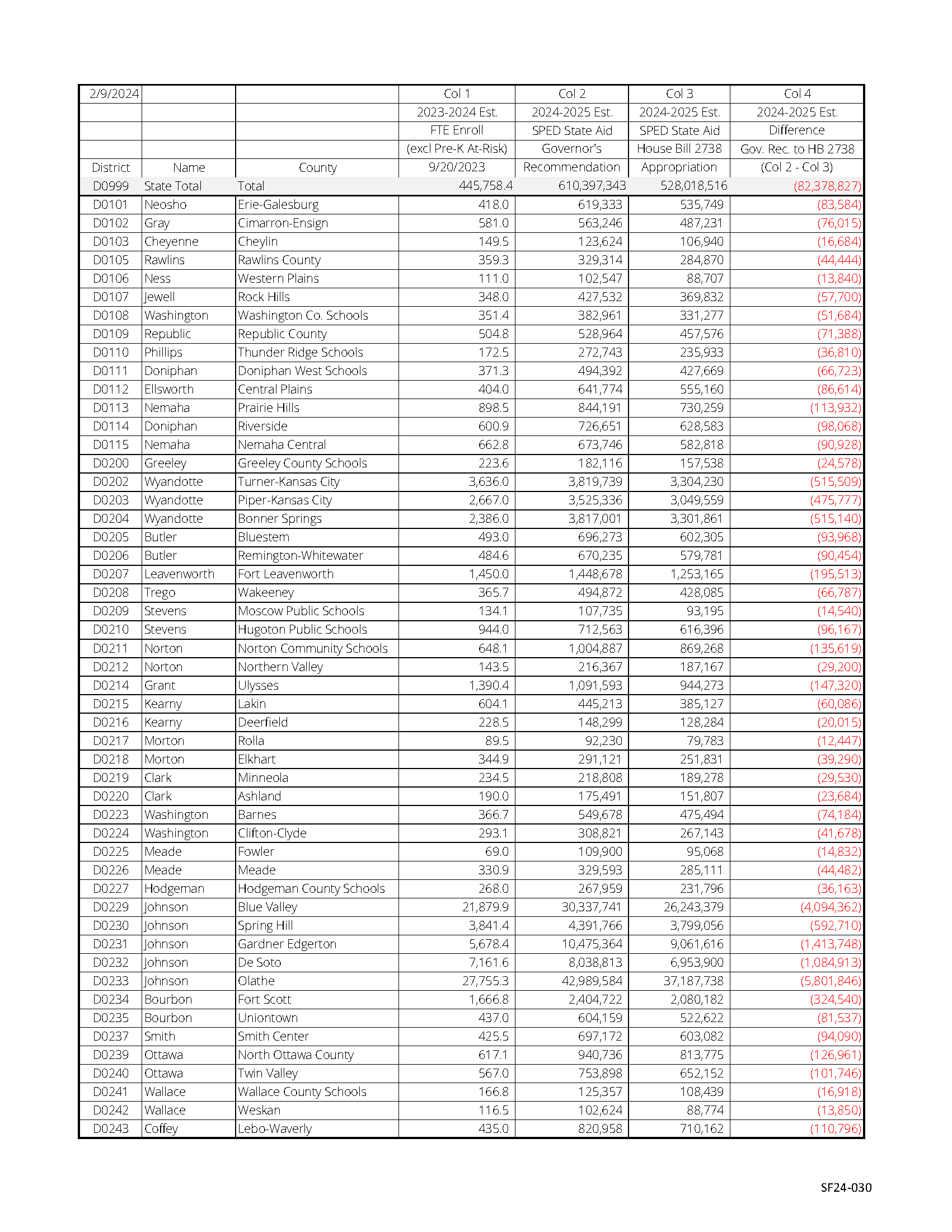
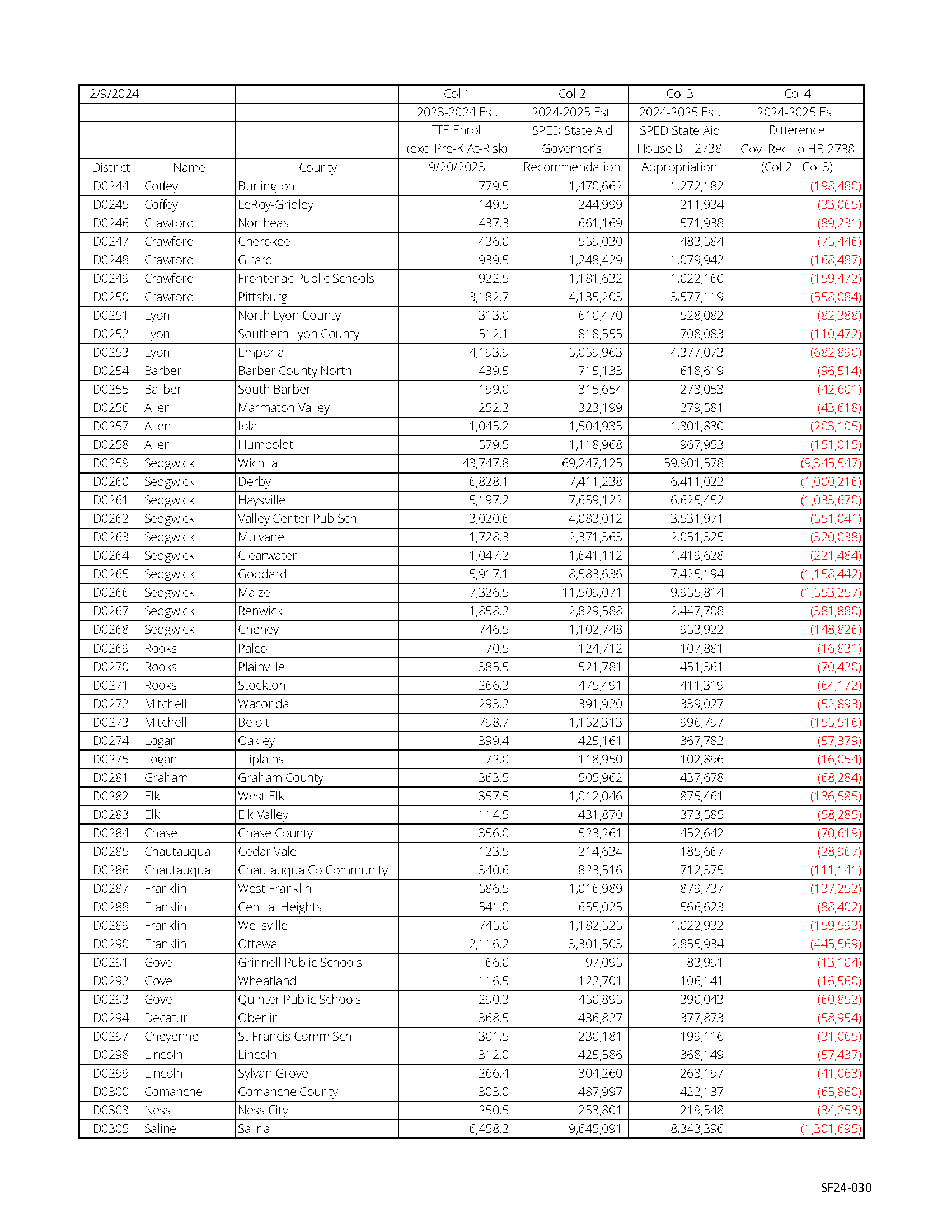
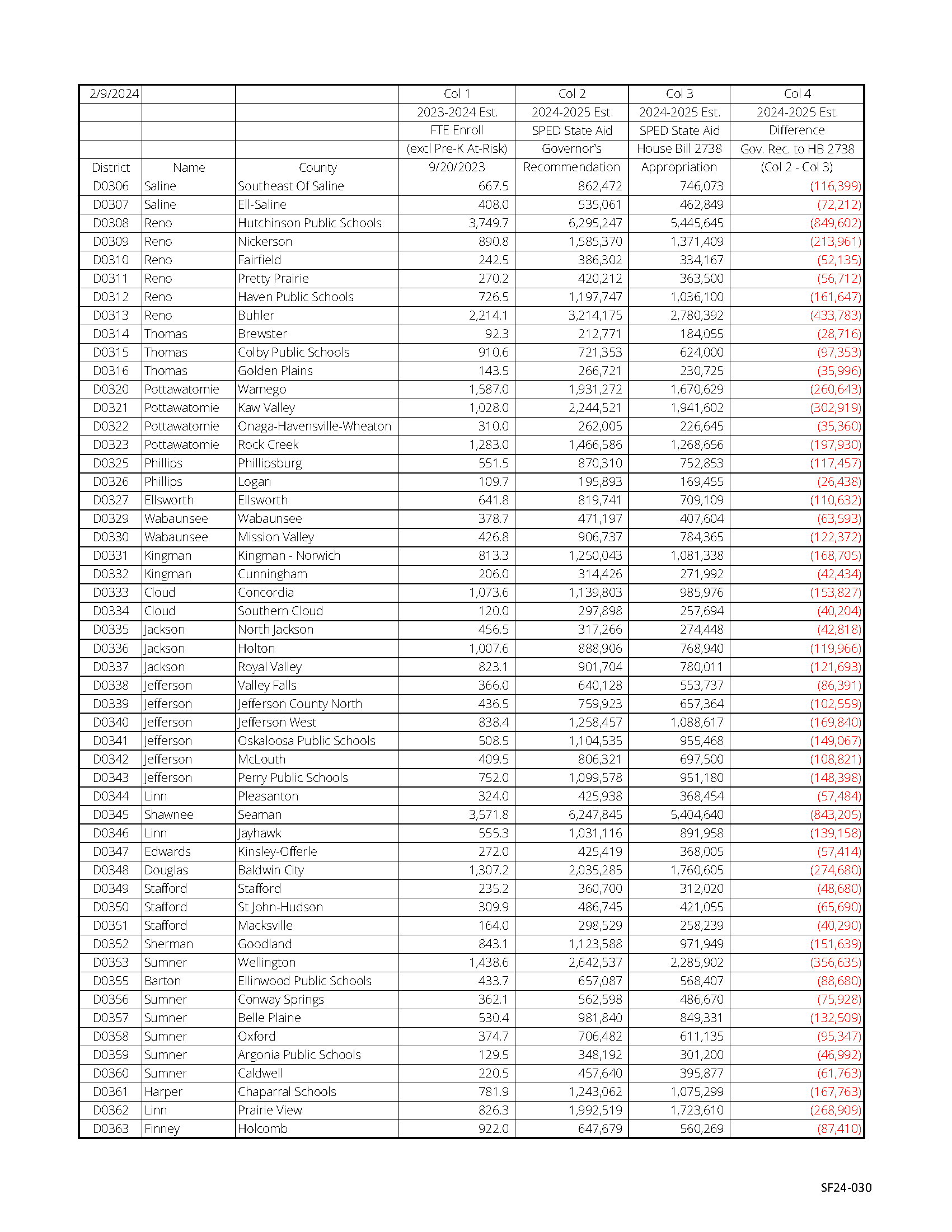
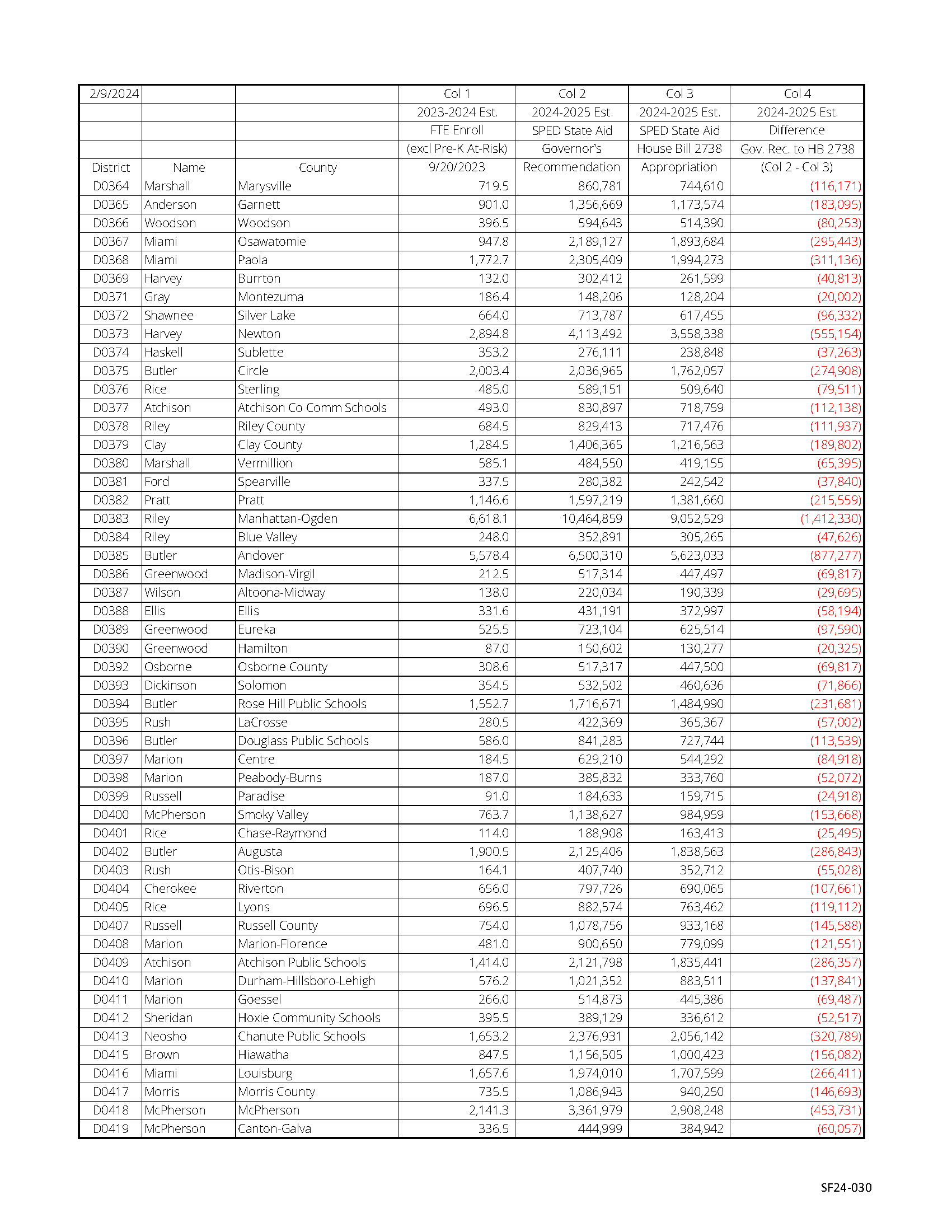
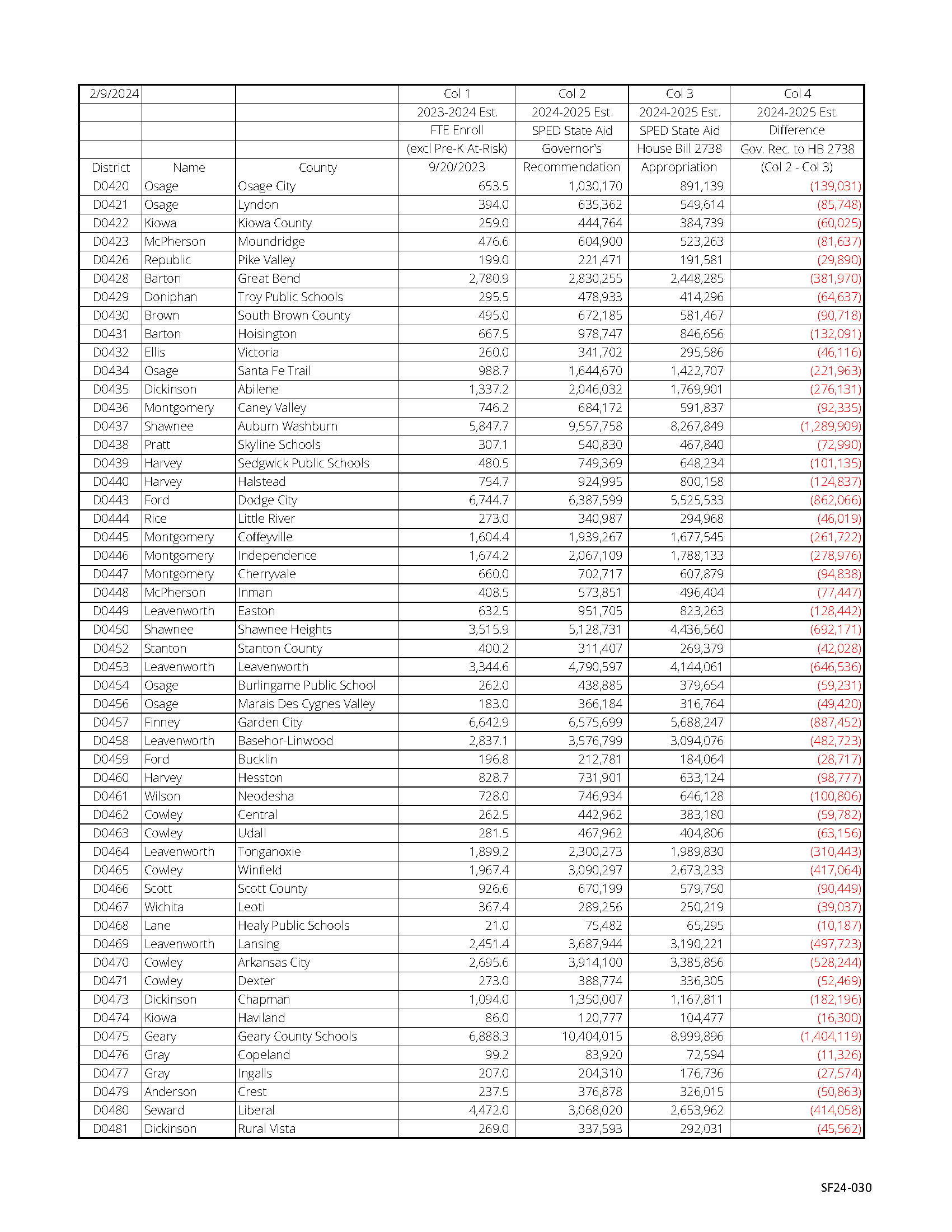
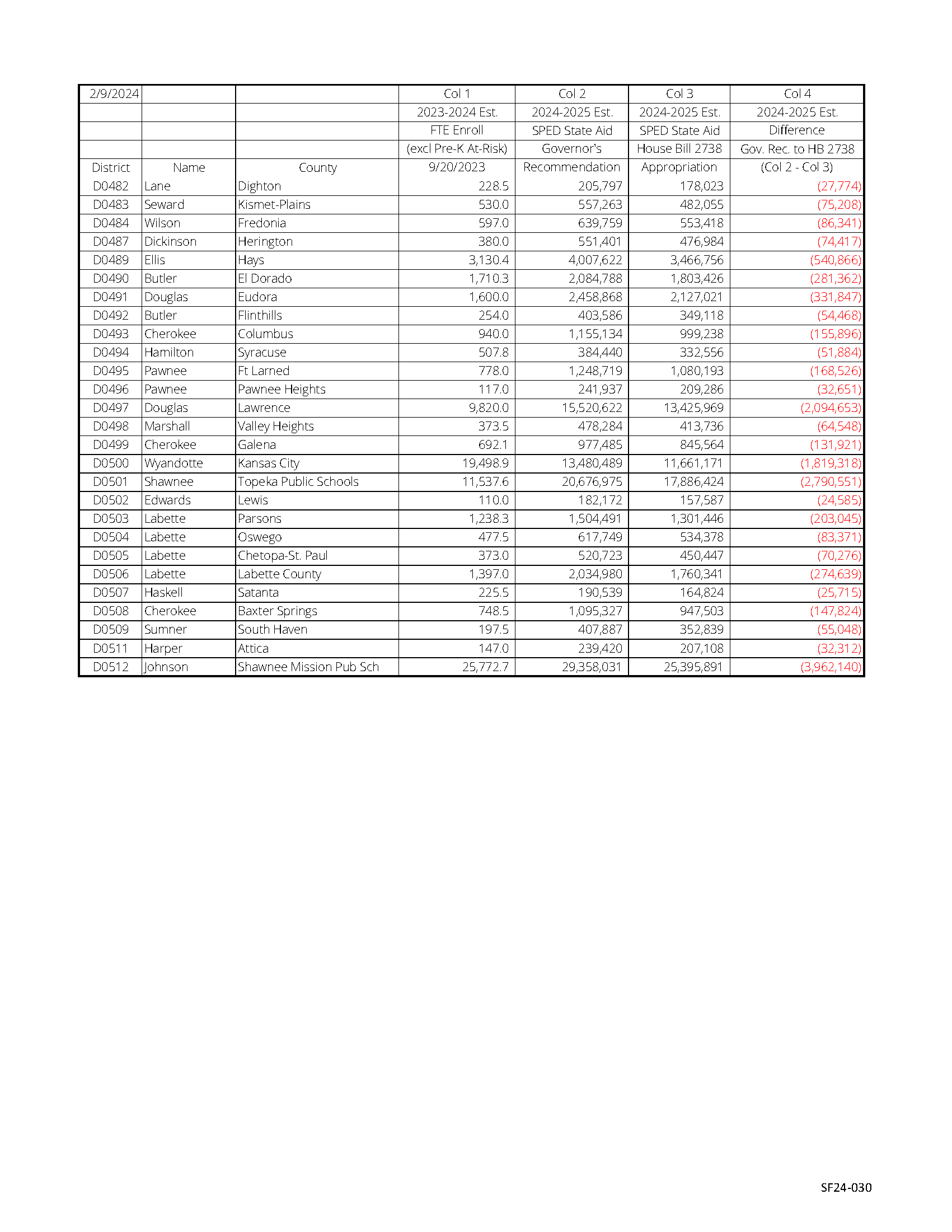
Newsletter #4Legislative Session Update
Kansas Association for Rural Education
Newsletter #4
For Week of January 29 to February 2, 2024
Jim Karleskint
As we conclude the week we watch what the Ground Hog will tell us what we can expect weather wise for the next 6 weeks. There is still a great deal of discussion on the vetoed Flat Tax Bill. Last week Governor Kelley vetoed the legislation to create a flat tax for Kansas residents. There is also other tax cutting measures in the bill which the Governor is in agreement with. It is anticipated the House will attempt to take the override vote next week. Leadership in the House indicates there are enough votes in the House to override. However, in the Senate there is not the confidence of having the votes to override. The legislature has 30 to override the veto. Hopefully if the veto does not take place lawmakers will return to the negotiation table to work out a plan that will benefit the folks of Kansas.
To recap the week and look to next week. On Monday, January 29th. House K-12 Education Budget Committee heard HB 2594. This bill establishes an education task force to review and make recommendations to the state’s school finance formula that will be revised by 2027. The bill also abolishes the Special Education task force that was created last year. Many present that testified made suggestions regarding the make up of the task force. I testified there is a lack of real world school finance experience on the make up of the task force. Also, expressed concern the Special Education task force that was created in legislation last year (and only met once) will be disbanded.
On Tuesday, Senate Education heard SB 386. This bill is an identical bill of HB 2485 that was heard recently in K-12 Budget. It uses current year student count or one previous year. Testimony was similar to what we heard in House K-12 Budget on the bill. Leadership on the Senate and House committees appear to be in favor of counting students that are currently enrolled in the school district. Please let you Representative and Senator know how this legislation will impact your district.
A survey was sent to school districts to request information on the number of AED machines currently in schools, number of staff trained in CPR, and how many districts have an Emergency Response Plan in place. As I have discussed before there is an AED bill in House Education. Chair Adam Thomas is working with parties from the American Heart Association, KSDE, State School Board, KDHE, KSHSAA, KNEA, KASB, USA Kansas, and KARE to come up with a workable plan. He hopes to work the bill in committee next week. Another unfunded mandate is being addressed in the discussions.
In looking ahead to next week. We are at a point in the session when committees will be working bills already heard in preparation to get the bills to the House or Senate floor for passing or not. By the end of February most bills need to be heard by either the House or the Senate to become a reality.
Monday, February 5th. House K-12 Education Budget will hear HB 2612 would require districts to be in compliance with all state laws and rules and regulations to be accredited and requires the state board of education to establish a process to challenge determinations of such compliance. This is really a bad bill, the chair basically put it on the calendar to keep many from providing testimony. Time will tell what type of momentum the bill will get, more on it later.
Wednesday, February 7th. House K-12 Education Budget will hear HB 2650 would require school districts to establish an at-risk accountability plan and to show academic improvement in certain subgroups and students identified as eligible for at-risk programs, prohibiting the state board of education from revising the curriculum standards in English Language Arts and Math until 75% of all students achieve proficiency requiring school districts to comply with all state laws and rules and regulations to maintain accreditation. The bill being heard on Monday is bad but this one is worse. The expectation on proficiency is for at risk kids to achieve a 3 or 4 on the state assessment. There is time to provide testimony on this bill. Please submit testimony on HB 2650 to House K-12 Education Committee, it is due by 3:30 on Monday.
Thursday, February 8th. House K-12 Education Budget will hear HB 2521 would require the state board of education to authorize teaching licenses for individuals who complete an alternative teacher certification program. This bill will meet resistance from some due to not requiring some of the traditional teacher licensure practices.
Also on Thursday in the Senate Education Committee will hear SB 407. This bill is identical to the one above being herd in House K-12 Education Budget on teacher licensure.
As stated Education Committees will also be working bills that have previously been heard. I will let you know what gets out of committees, the next step is for the bills to be placed on the calendar for consideration of the full House and Senate. Have a great week.
Reminder:
Wednesday, March 6 is KARE Day at the Capital.
Will start at 8 AM. Please try and make it to Topeka to speak with Legislators.
Newsletter #3Legislative Session Update
Kansas Association for Rural Education
Newsletter #3
For Week of January 22 to 26, 2024
Jim Karleskint
Before I begin the update from the past week I want to let everyone know that I have set the date of March 6th as the day for members of KARE (Kansas Association for Rural Eduction) to visit the Capital and meet with legislators. I strongly encourage you to come to Topeka that day and meet with your legislators and others that may not represent you. There are many things that will be impacting rural districts this session. HB 2485 and SB 386, these bills are identical and has do with current year funding and look back funding. Read below for more details.
The weather continued to make its mark on Kansas this past week. I’m looking forward to a good week of weather soon. Probably one of the most significant bill hearings to take place in the new legislative session took place on Monday. On January 22nd the K-12 House Education Budget committee heard HB 2485. The bill has to do with using current year enrollment or the preceding year enrollment for the districts enrollment count to determine funding. School districts representatives presented both sides of the issue to the committee. One statement made by Committee Chair Kristy Williams was “We want to fund real students in real seats” she went on to say “We’re going to help fund kids where those kids are”. The committee received a print out of how districts faired last year following the passage of SB 113.
HB 2485 has not been worked to pass out of committee. And move to the floor of the House to be heard. I’m confident it will be passed out of committee in the near future, changes could be made to the current bill but that remains to be seen. We know what Chair Williams wants in this legislation. I would encourage you to contact your representative from the House to let him/her know how this could impact your district.
On Tuesday, January 30 the Senate Education Committee will hear an exact copy of this bill. The Senate Bill is SB 386. I would suggest that you contact your senator to let him/her know how this impacts your district.
On Wednesday House K-12 Education Budget committee heard HB 2489. The bill would limit the legislative option to purchase school district buildings to buildings that were formerly used as attendance centers. This is a clarification to legislation from last year in SB 113. The committee heard from school districts both proponent and opponent on the bill. The Attorney General provided an opinion earlier on this bill. It stated “Allowing the state to acquire a school building that was paid for with local funds appears to be inequitable.
Also on Wednesday the committee heard HB 2506. The bill would authorize students enrolled in virtual schools to participate in activities that are regulated by the Kansas State High School Activities Association at such student’s resident school district without a minimum enrollment requirement in such resident school district. There were several that provided proponent testimony. Bill Faflick, Executive Director of KSHSAA provided neutral testimony telling the committee that the Board of Directors of KSHSAA would be addressing the issue and taking care of this and there is no need to pass a law on this issue. Some committee members disagreed and felt it should be in statute.
On Thursday also in House K-12 Education Budget Committee the committee heard HB 2514. This bill attempts to clarify language from the Open Enrollment bill SB 113 that was passed last year. The bill provides language on school districts accepting out of district students that are not in good standing. I provided neutral testimony with language suggestions.
In looking ahead to next week House K-12 Education Budget will have a slower week compared to the past week. The busy Education Committee will be Senate Education. There are 3 hearings to be held in Senate Education next week.
Monday, January 29th. House K-12 Education Budget Committee will hear HB 2594. This bill establishes an education task force to review and make recommendations with respect to the state’s school finance formula that will be revised by 2027. The bill also abolishes the Special Education task force that was created last year. There will be testimony provided to make suggestions regarding the make up of the task force. In my opinion there is a lack of real world school finance experience on the make up of the task force.
Monday, January 29th. Senate Education will hear SB 387. This bill is yet another bill to clean up language and clarify points from SB 113 that was passed last year.
Tuesday, January 30th. Senate Education will hear SB 386. This bill is a mirror bill of HB 2485 that was heard last week in K-12 Budget. Using current year student count or one previous year. I anticipate similar testimony will be heard as what took place last Monday in K-12 Budget.
Wednesday, January 31st. Senate Education will hear SB 360. The bill has to do with tax-advantaged savings programs; allowing the taxpayer to elect the taxable year in which a subtraction modification for contributions to 529 qualified tuition accounts. ABLE accounts or first-time home buyer savings accounts would be applied; authorizing the state treasurer to appoint a 529 program advisory council; amending
I want to recommend again that you let you Representative and Senators know how legislation could impact you school district. If you have questions please contact me. Until next week.
Newsletter #2Legislative Session Update
Kansas Association for Rural Education
Newsletter # 2
For Week of January 15 to January 20, 2024
The past week was shortened with the Martin Luther King Jr. holiday on Monday. When the legislature did return to Topeka there was an emphasis on taxes by both houses. On Tuesday the House and Senate Tax Committees worked on a compromise bill that established a flat tax, cuts property taxes, eliminates taxes on Social Security income, increases standard deduction and raises personal tax exemption. Then on Wednesday the Senate approved the bill with a vote of 25 to 11, on Thursday the House approved the bill with 81 voting in favor and 37 opposed, the bill now goes to the Governor. Governor Kelly has indicated she is opposed to a flat tax. If she vetoes the bill it will be close vote on overriding the veto. We should know in a week or two.
Education committees this week spent the majority of their time receiving briefings on topics ranging from reading instruction in schools, computer literacy, and updates from the Kansas Department of Education on financial matters.
On Wednesday, the House Education committee heard the Cardiac Emergency Response Plan legislation. It requires districts to have AED’s in all buildings, specific number of staff trained in CPR, and an Emergence Response Plan in place. The hearing saw 4 families share their experiences of a child who had a serious cardiac event. There were fatal outcomes shared and near death experiences also. The need for AED machines to be available was emphasized in all the experiences shared by the families. There is work that needs to be done on the bill prior to bring it up for action by the committee. Chairman Thomas is working with representatives of the American Heart Association, State School Board, KNEA, KASB, and USA to get further input. Last week there was a survey sent out to seek information from districts on number of machines currently in buildings, number of staff trained, and if an Emergency Response Plan is in place. If you have not responded to that surgery please do. The information is needed to determine costs related to the legislation.
In looking toward next week and legislation that will be heard.
Monday, January 22 at 3:30 PM
House K-12 Education Budget will hear HB 2485. The bill has to do with requiring enrollment under the Kansas school equity and enhancement act to be determined using current school or the preceding school year and requiring any distinct that closed a school building in the preceding school year to use current year enrollment count. This legislation has an impact on all districts. I would encourage you to share with your legislator how this bill will impact your district.
Wednesday, January 24 at 3:30 PM
House K-12 Education Budget Committee will hear HB 2489. The bill would limit the legislative option to purchase school district buildings to buildings that were formerly used as attendance centers. This is a clarification to legislation from last year on SB 113. This does not pertain to many districts but if it does I would encourage you to submit testimony or speak to your legislator.
Thursday, January 25 at 3:30 PM
House K-12 Education Budget Committee will hear HB 2506. The bill would authorize students enrolled in virtual schools to participate in activities that are regulated by the Kansas State High School Activities Association at such student’s resident school district without a minimum enrollment requirement in such resident school district. If you have a view on this legislation I would encourage you to provide testimony or contact your legislator.
Please note when submitting testimony most committees have a deadline of submission 24 hours prior to the hearing (business hours). However, Chair Williams on K-12 Education Budget has a 48 hour requirement. For a Monday hearing the requirement for all committees except K-12 Budget would be Friday, K-12 Education Budget would the previous Thursday at 3:30 PM.
If you have questions please contact me, things are starting to pick up in the Kansas Legislature.
Jim Karleskint, PhD
KARE (Kansas Association for Rural Education)
Legislative Services
785-550-4298
Newsletter #1Legislative Session Update
Kansas Association for Rural Education
Newsletter #1
For Week of January 8 to January 12, 2024
The 2024 Kansas Legislative session has started. Since this is the second year of the 2-year session there was very little procedural work to complete to begin the session.
There hasn’t been a great deal that has taken place this week. The snow storm that visited Kansas on Tuesday brought most activity at the Capital to a halt. On Wednesday evening the Governor delivered her annual State of the State Address.
On Thursday the Governor’s budget was released, this is how it pertains to education.
Early Childhood is receiving significant attention from the Governor this year. She purposes to spend $56.4 million in new money on Early Childhood education. The money will go toward the early childhood workforce, expand access to child care slots, and cut taxes for working families.
In K-12 education the Governor continues to uphold her commitment to fully fund education as dictated by the Gannon case. The key piece to the Gannon case for this year is the CPI adjustment. This sets the base at $5,381 for FY 25 and $5623 for FY 26. The budget also purposes to fully fund special education over a 5-year period to the 92% of excess costs. For FY 25 this would be an increase of $79.9 million. Please keep in mind this is similar to what the Governor recommended last year. This amount was cut out of the budget when it went to the House K-12 Education Budget Committee.
Education Committees did not hear any bills this week. The meeting times were spend primarily on receiving briefing from KSDE on a variety of topics. Updates are scheduled for next week as well.
Looking to next week. There is one bill that will be heard in the House Education Committee on Wednesday at 1:30 in Room 218N. The bill was introduced on Wednesday. The bills title is Cardiac Emergency Response Plan legislation. The bill would require all schools to have a AED machine, have a specific number of staff trained in CPR, and have a Cardiac Emergency Response Plan in place. The bill is sponsored by the American Heart Association. It is unusual to have a hearing so quickly. In speaking with Chairman Thomas of the committee he told me this Wednesday is American Heart Association day at the Capital. Since there will be many people at the Capital that day with interest in the bill he is holding a hearing.
I understand the AHA’s desire to keep as many people as safe as possible and I agree with that stand. However, my concerns with this bill it has the potential of another unfunded mandate for schools and there is not enough information on what schools currently have. On Wednesday there was a survey sent out by USA to determine where schools in Kansas are with respect to AED machines in each building, how many staff are trained in CPR, and how many districts have a Emergency Response Plan is place. Please respond to the USA survey or let me know where you school district is on number of AED machines, number of staff trained in CPR, and whether or not your district has an Emergency Response Plan?
Also the coming week we will see a great deal of attention placed on tax legislation. Republican leadership in the Legislature wants to get legislation passed as quickly as possible. Republican leadership is pushing for a flat income tax. The type of legislation was passed late in the session last year. The Governor vetoed the bill, the override attempt failed by just a couple of votes. With this being an election year there is a strong desire to get tax cuts in place. The Governor has indicated she continues to oppose a flat tax. Stay tuned.
If there are questions please contact me.
Regards,
Jim Karleskint
Jim Karleskint, PhD
KARE (Kansas Association for Rural Education)
Legislative Services
785-550-4298
No legislative updates match that search.